
Context
- Recently, Vice-Admiral Ajay Kochhar assumed charge as the 48th Vice-Chief of the Naval Staff. The newly appointed Vice-Chief, who previously spearheaded high-level naval combat readiness during Operation Sindoor, marked this milestone in a distinguished naval career spanning more than 37 years by paying tribute to the nation’s fallen heroes at the National War Memorial in New Delhi.
1. Commissioned Officer Ranks (Top to Bottom Hierarchy)
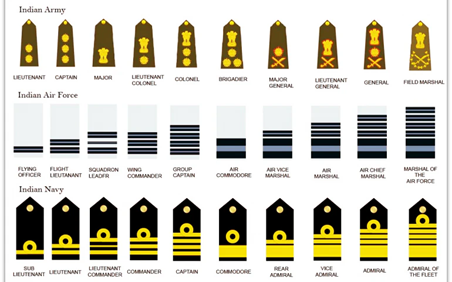
The table below illustrates the exact corresponding ranks across the three branches, from the highest active operational profile down to the entry-level operational rank.
| Rank Level | Indian Army | Indian Navy | Indian Air Force |
| 4-Star (Chief) | General | Admiral | Air Chief Marshal |
| 3-Star | Lieutenant General | Vice Admiral | Air Marshal |
| 2-Star | Major General | Rear Admiral | Air Vice Marshal |
| 1-Star | Brigadier | Commodore | Air Commodore |
| Senior Level | Colonel | Captain | Group Captain |
| Mid-Senior Level | Lieutenant Colonel | Commander | Wing Commander |
| Intermediate | Major | Lieutenant Commander | Squadron Leader |
| Junior Level | Captain | Lieutenant | Flight Lieutenant |
| Entry Level | Lieutenant | Sub-Lieutenant | Flying Officer |
2. Honorary and Wartime Five-Star Ranks
Five-star ranks are ceremonial positions of honor awarded for exceptional wartime leadership and outstanding service. Officers who receive these ranks hold them for life and are considered active personnel until their demise.
- Indian Army: Field Marshal (Conferred upon Sam Manekshaw and K.M. Cariappa).
- Indian Navy: Admiral of the Fleet (No naval officer has been conferred this rank to date).
- Indian Air Force: Marshal of the Indian Air Force (Conferred upon Arjan Singh).
Non-Officer Cadre and Junior Structures
Below the commissioned officer ranks are the personnel who manage ground-level discipline, execution, and specialized equipment handling.
1. Junior Commissioned Officers (JCOs)
Junior Commissioned Officers act as a critical bridge between the commissioned officers and the enlisted troops. The Indian Army and Indian Navy utilize distinct titles for this cadre, whereas the Indian Air Force classifies equivalent senior non-commissioned positions under Warrant Officer categories.
- Indian Army: Subedar Major, Subedar, and Naib Subedar.
- Indian Navy: Master Chief Petty Officer 1st Class, Master Chief Petty Officer 2nd Class, and Chief Petty Officer.
- Indian Air Force: Master Warrant Officer, Warrant Officer, and Junior Warrant Officer.
2. Non-Commissioned Officers (NCOs) and Enlisted Personnel
This cadre constitutes the bedrock of operational forces, responsible for executing tactical tasks and maintaining unit discipline.
- Indian Army: Havildar, Naik, Lance Naik, and Sepoy.
- Indian Navy: Petty Officer, Leading Seaman, Seaman 1st Class, and Seaman 2nd Class.
- Indian Air Force: Sergeant, Corporal, Leading Aircraftsman, and Aircraftsman.
Q. Consider the following statements regarding the rank structure of the Indian Armed Forces:
Statement I: A Wing Commander in the Indian Air Force holds an equivalent rank to a Lieutenant Colonel in the Indian Army and a Commander in the Indian Navy.
Statement II: Five-star ranks across the three branches of the Indian military are active operational posts that are regularly assigned during peacetime structural rotations.
Which one of the following is correct in respect of the above statements?
(a) Both Statement I and Statement II are correct and Statement II is the correct explanation for Statement I.
(b) Both Statement I and Statement II are correct and Statement II is not the correct explanation for Statement I.
(c) Statement I is correct but Statement II is incorrect.
(d) Statement I is incorrect but Statement II is correct.
Solution & Explanation
Correct Answer: (c)
• STATEMENT I is CORRECT: According to the established rank-equivalence matrix of the Indian Armed Forces, the mid-senior selection grade officer ranks correspond directly across services. A Wing Commander (Indian Air Force), a Lieutenant Colonel (Indian Army), and a Commander (Indian Navy) are equivalent designations sharing the same salary scale, protocol position, and responsibilities within their respective wings.
• STATEMENT II is INCORRECT: Five-star ranks, which include the Field Marshal in the Army, Admiral of the Fleet in the Navy, and Marshal of the Indian Air Force, are strictly ceremonial and honorary titles. They are not routine peacetime appointments nor do they feature in standard administrative rotations. They are conferred only under extraordinary wartime circumstances for monumental leadership, and the officers retain the rank for life without entering active tactical command structures during peacetime.