
Context
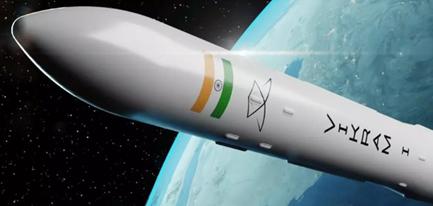
- Skyroot Aerospace is set to launch Vikram-1, India’s first privately developed orbital launch vehicle, from the Satish Dhawan Space Centre (SDSC), Sriharikota.
- The maiden mission, named Mission Aagman, is scheduled for launch between July 12 and August 4, subject to weather, range clearance, and completion of launch preparations.
- The mission follows the successful suborbital test of Vikram-S in 2022 and marks a major milestone in India’s private space sector.
About Vikram-1 Launch Vehicle
I. Key Features
- Developer: Skyroot Aerospace (Hyderabad-based private space startup)
- Type: It is a four-stage, expendable orbital small-lift launch vehicle, its first three stages are solid stages, while the fourth stage is a liquid stage.
- Payload Capacity:
- Around 300 kg to Low Earth Orbit (LEO).
- Suitable for launching small satellites.
- Mission: First orbital mission named Mission Aagman.
- Launch Site: Satish Dhawan Space Centre (SDSC), Sriharikota.
II. Objective
- Demonstrate the capability of India’s private sector to independently place satellites into orbit.
- Offer affordable and dedicated launch services for the global small satellite market.
- Strengthen India’s commercial space ecosystem.
Mission Aagman
- Marks the first orbital mission of Skyroot Aerospace.
- Planned as a partially commercial mission.
- Carries customer payloads along with technology demonstration payloads.
- If successful, commercial launches are expected to begin after two demonstration missions.
Technological Features
- Carbon composite structures for reduced weight.
- Extensive use of 3D-printed rocket components.
- Fully integrated avionics for:
- Navigation
- Guidance
- Flight control
- Telemetry
- Designed for rapid production and lower launch costs.
About Skyroot Aerospace
- Founded in 2018.
- Headquarters: Hyderabad.
- First Indian private company to successfully launch a rocket (Vikram-S) in 2022.
- Named its launch vehicles after Dr. Vikram Sarabhai, the father of the Indian space programme.
With reference to Vikram-1, consider the following statements:
1. It is India's first privately developed orbital launch vehicle.
2. It is being developed by Agnikul Cosmos.
3. It is designed to place small satellites into Low Earth Orbit (LEO).
Which of the statements given above is/are correct?
(a) 1 and 2 only
(b) 2 and 3 only
(c) 1 and 3 only
(d) 1, 2 and 3
Answer: B
Explanation:
•  Statement 1 is correct: As highlighted in the provided text, Vikram-1 is indeed India’s first-ever privately developed orbital-class rocket/launch vehicle. Its precursor, Vikram-S (launched in November 2022), was a suborbital rocket.
•  Statement 2 is incorrect: Vikram-1 is being developed by Skyroot Aerospace, a private aerospace manufacturer based in Hyderabad. Agnikul Cosmos is another prominent Indian private space startup, but they are developing a different launch vehicle named Agnibaan.
•  Statement 3 is correct: Vikram-1 is a multi-stage, small-lift launch vehicle designed specifically to carry small satellites (weighing up to 350 kg) into Low Earth Orbit (LEO) at an altitude of approximately 450 km.