
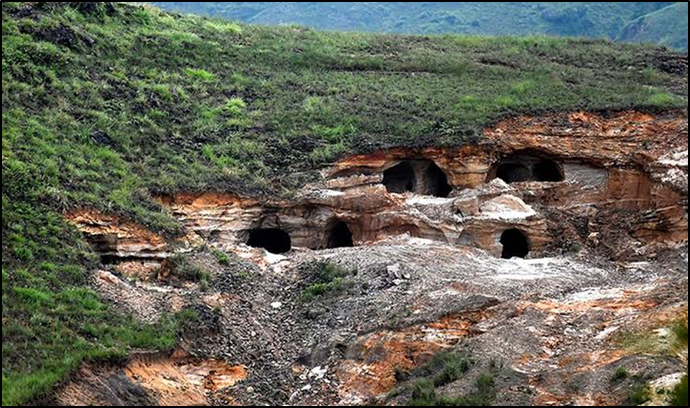
Context
- A High Court-constituted committee headed by retired Justice B.P. Katakey has criticised the Meghalaya Government for failing to adopt a comprehensive policy for closing and securing abandoned rat-hole coal mines.
- The committee has highlighted the risks posed by thousands of abandoned mine openings to human beings, livestock and the environment, and has stressed the need for immediate preventive measures.
What is Rat-Hole Mining?
- Rat-hole mining is an unscientific and hazardous method of extracting coal through very narrow horizontal tunnels dug into coal seams.
- The tunnels are often so narrow that workers have to crawl through them.
- It became particularly prevalent in Meghalaya, where coal seams are often thin and shallow.
- Mining has traditionally taken place on privately or community-owned tribal land, creating a complex relationship between customary land rights and statutory mining regulation.
Why is it called “Rat-Hole”?
- The narrow tunnels resemble the small burrows of rats, through which miners enter the coal seams.
Why is Rat-Hole Mining Dangerous?
1. Human Safety
- Narrow and unstable tunnels increase the risk of collapse, flooding and entrapment.
- Abandoned shafts remain dangerous even after mining operations stop.
2. Environmental Damage
- Unscientific coal extraction causes land degradation and soil instability.
- Acidic mine drainage can contaminate streams, rivers and groundwater.
- It can adversely affect forests, biodiversity and aquatic ecosystems.
3. Abandoned Mine Openings
- Open mine shafts can become death traps for people and livestock.
- Therefore, merely stopping mining is insufficient; mine closure and land restoration are also necessary.
NGT Ban – 2014
- The National Green Tribunal (NGT) ordered the Meghalaya Government in April 2014 to stop rat-hole mining and illegal coal mining throughout the State.
- The order also prohibited transportation of illegally mined coal. The proceedings followed serious concerns over deaths of mine workers and environmental degradation.
- The ban was not merely about coal extraction; it also addressed the transportation and subsequent handling of illegally mined coal.
Supreme Court Judgment – 2019
- In State of Meghalaya v. All Dimasa Students Union, the Supreme Court upheld the NGT’s action against unscientific rat-hole mining.
- Rat-hole mining as an unscientific method remains prohibited.
- The judgment did not mean that all coal mining in Meghalaya is permanently prohibited.
- Legal and scientific mining, if conducted according to the applicable statutory framework, is not barred.
- The Court emphasised that natural resources must be managed in the interests of present and future generations.
What is the Katakey Committee Highlighting?
- Absence of a comprehensive mine-closure policy.
- Large numbers of abandoned mine openings that remain unsecured.
- Need for fencing and immediate preventive measures.
- Need for land restoration and rehabilitation.
- Delays in implementing proposals for mine closure and restoration.
- The committee has also highlighted restoration projects prepared by the Central Mine Planning and Design Institute (CMPDI) for Meghalaya.
Why Mine Closure Matters?
- A responsible mining policy follows a complete cycle:
- Mining → Environmental Management → Mine Closure → Land Restoration → Rehabilitation
- Therefore, mine closure is not an optional post-mining activity; it is an essential component of sustainable mining governance.
Major Laws Relevant to Mining
- Mines and Minerals (Development and Regulation) Act, 1957 (MMDR Act)
- Mines Act, 1952
- Environment (Protection) Act, 1986
- Water (Prevention and Control of Pollution) Act, 1974
- Air (Prevention and Control of Pollution) Act, 1981
Q. With reference to rat-hole mining in Meghalaya, consider the following statements:
1. The National Green Tribunal banned rat-hole coal mining in Meghalaya in 2014.
2. The Supreme Court upheld the prohibition on unscientific rat-hole mining in 2019.
3. The Sixth Schedule provides an unrestricted constitutional exemption to Meghalaya from central mining and environmental laws.
Which of the statements given above is/are correct?
A. 1 and 2 only
B. 1 and 3 only
C. 2 and 3 only
D. 1, 2 and 3
Answer: A. 1 and 2 only
• Statement 1 – Correct: The NGT banned rat-hole mining in Meghalaya in 2014.
• Statement 2 – Correct: The Supreme Court upheld the prohibition on unscientific rat-hole mining in 2019.
• Statement 3 – Incorrect: Sixth Schedule autonomy does not provide an unrestricted exemption from applicable central mining and environmental laws.