
Context
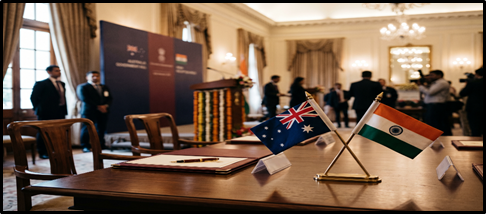
- Australia and India have completed all the necessary formalities for Australia to export uranium to India for civilian nuclear power.
- Australia and India have completed all formalities for civilian uranium exports. The fuel is strictly restricted to peaceful energy generation—excluding weapons use—under mandatory IAEA monitoring.
Key Points of the India–Australia Uranium Supplies Agreement
- Strategic Sourcing: Secures a stable uranium supply from Australia, which possesses over 25% of global reserves.
- NPT Exemption: India remains a rare exception to Australia’s strict Non-Proliferation Treaty (NPT) requirement, granted due to India’s clean non-proliferation record.
- IAEA Safeguards: Mandates the separation of civilian and military nuclear facilities to facilitate regular international inspections under the 2008 IAEA agreement.
- Peaceful Use Guarantee: Builds on the 2015 bilateral pact through a new administrative arrangement to ensure imported uranium is strictly utilized for peaceful energy generation.
- NSG Waiver Facilitation: The partnership is fundamentally enabled by the special 2008 trade waiver granted to India by the 48-nation Nuclear Suppliers Group (NSG).
India’s Nuclear Power Sector (Current Status).
India holds roughly 25% of the world’s thorium reserves — among the largest in the world — mostly found in monazite sands along the coasts of Kerala, Tamil Nadu, Odisha, and Andhra Pradesh.
Power Generation
- Total installed power capacity: ~520 GW (Jan 2026).
- Largest sources: Thermal > Renewables > Hydropower > Nuclear.
- Nuclear power remains one of India’s smallest electricity sources, but plays a vital role in providing clean, reliable 24×7 baseload power.
- 24 operational reactors with a combined capacity of 8.78 GW across 7 sites.
- Contributes about 3.1% of India’s electricity generation.
- Produced 56,681 million units (MU) of electricity in 2024–25.
- Most reactors are Pressurised Heavy Water Reactors (PHWRs) operated by NPCIL under the Department of Atomic Energy (DAE).
India’s Three-Stage Nuclear Programme
- Objective: To achieve long-term energy self-sufficiency by systematically leveraging India’s vast domestic thorium reserves through a sequential process.
- Stage 1 (Pressurised Heavy Water Reactors): Operates using natural or enriched uranium as the primary fuel.
- Stage 2 (Fast Breeder Reactors): Utilizes plutonium (extracted from Stage 1) alongside uranium-238 to breed more fissile material than the reactor consumes.
- Stage 3 (Thorium-Based Reactors): Powered by uranium-233 (bred from thorium introduced in Stage 2) to fully harness the nation’s thorium resources.
Nuclear Expansion Targets & Policy Reforms
- Capacity Goals: Aims to scale capacity to 22.48 GW by 2031–32 and 100 GW by 2047 under the Nuclear Energy Mission.
- Stage 2 Transition: The 500 MWe Prototype Fast Breeder Reactor (PFBR) at Kalpakkam achieved its first criticality in April 2026, marking India’s entry into the second stage of its nuclear programme.
- Legislative Amendments: Proposes revisions to the Atomic Energy Act, 1962, and the Civil Liability for Nuclear Damage Act, 2010.
- Private Sector Integration: Seeks to boost private sector participation through the proposed legislative amendments and the introduction of the SHANTI Act
| Why SHANTI ACT matters for this specific uranium deal? The 2026 Administrative Arrangements allow private Australian companies to sell uranium to eligible private Indian companies and joint ventures. The SHANTI Act allows private companies to participate in India’s civilian nuclear sector. Without it, only DAE/NPCIL could import uranium. In simple terms: The SHANTI Act creates private buyers in India, while the Australia agreement provides the uranium supply, strengthening India–Australia civil nuclear cooperation. |
With reference to India’s nuclear energy sector and recent civil nuclear developments, consider the following statements:
1. The SHANTI Act permits private Indian companies and joint ventures to participate in the civilian nuclear sector, enabling them to import uranium alongside public entities like DAE and NPCIL.
2. Thorium is a directly fissile material capable of sustaining an independent nuclear chain reaction, eliminating India's reliance on imported uranium for its long-term nuclear ambitions.
3. The first criticality of the 500 MWe Prototype Fast Breeder Reactor (PFBR) at Kalpakkam marks India’s transition into the second stage of its three-stage nuclear programme.
Which of the statements given above is/are correct?
(a) 1 and 2 only
(b) 2 and 3 only
(c) 1 and 3 only
(d) 1, 2 and 3
Answer: (c)
Explanation
• Statement 1 is correct: Historically, only the Department of Atomic Energy (DAE) and the Nuclear Power Corporation of India Limited (NPCIL) were permitted to import uranium. The SHANTI Act opens up the civilian nuclear sector to private companies, which, combined with the 2026 Administrative Arrangements, allows private Australian companies to sell uranium directly to eligible private Indian companies and joint ventures.
• Statement 2 is incorrect: Thorium is not directly fissile and cannot sustain a nuclear chain reaction on its own, unlike uranium-235. It must first be converted into a usable fuel (uranium-233) inside a reactor using plutonium or enriched uranium as a trigger. Therefore, imported uranium remains vital to "kickstart" the process required to eventually tap into India's thorium reserves.
• Statement 3 is correct: India's three-stage nuclear programme progresses from Pressurised Heavy Water Reactors (Stage 1) to Fast Breeder Reactors (Stage 2). The 500 MWe Prototype Fast Breeder Reactor (PFBR) at Kalpakkam achieving first criticality serves as the primary milestone marking India's entry and transition into the second stage.