
Context
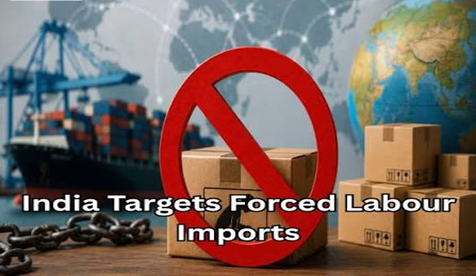
- Recently, India amended the Foreign Trade Policy (FTP), 2023 to ban the import of goods produced wholly or partly using forced labour. The move comes amid a U.S. Section 301 investigation and a proposed 12.5% tariff on Indian exports over the absence of such a prohibition.
Key Highlights of the Amendment
- The Prohibition: A new Paragraph 2.20B has been inserted into the FTP 2023, stating: “The import of goods produced or manufactured, wholly or in part, through the use of forced labour is prohibited”.
- Implementation Timeline: The provisions will take effect 30 days from their publication in the Official Gazette (issued on July 13, 2026).
- Enquiry & Enforcement Mechanism: The Central Government can notify specific prohibited goods based on enquiries conducted by the Director General of Foreign Trade (DGFT). The detailed inquiry procedures will be governed by the Handbook of Procedures, 2023.
- Formal Definition: The amendment adopted the definition of “Forced Labour” from the ILO Forced Labour Convention, 1930 (No. 29).
Background & International Context
- USTR Section 301 Probe: The US proposed tariffs on countries, including India, over alleged inadequate enforcement against imports made with forced labour.
- Regulatory Shift: Moves from relying only on domestic labour laws to a trade-based import ban, aligning India’s FTP with global supply-chain standards.
| International Labour Organization (ILO) Convention No. 29 · About Established: 1919. Became the first specialised agency of the United Nations in 1946. Headquarters: Geneva, Switzerland. Has a unique tripartite structure comprising governments, employers, and workers. · Important Conventions Convention No. 29 (Forced Labour Convention, 1930): Calls for the suppression of forced or compulsory labour in all its forms. Convention No. 105 (Abolition of Forced Labour Convention, 1957): Abolishes the use of forced labour in specified circumstances. India has ratified both Convention No. 29 and Convention No. 105. |
Consider the following statements regarding trade and labor standards in India:
1. The Directorate General of Foreign Trade (DGFT) is a statutory body under the Ministry of Finance.
2. India has ratified the International Labour Organization (ILO) Forced Labour Convention, 1930 (No. 29).
3. Article 23 of the Indian Constitution explicitly prohibits begar and other forms of forced labour.
Which of the statements given above are correct?
A) 1 and 2 only
B) 2 and 3 only
C) 1 and 3 only
D) 1, 2, and 3
Correct Answer: B (2 and 3 only)
• Statement 1 is incorrect: The DGFT is an attached office (not statutory) under the Ministry of Commerce and Industry (not the Ministry of Finance).
• Statement 2 is correct: India is a signatory to and has ratified the ILO Forced Labour Convention, 1930 (No. 29).
• Statement 3 is correct: Article 23 of the Constitution of India prohibits traffic in human beings, begar, and other similar forms of forced labour as a Fundamental Right.