
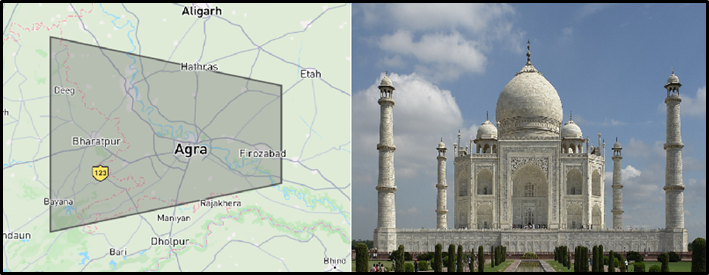
Context
The Supreme Court permitted the Taj Trapezium Zone (TTZ) Authority to process around 400 pending applications for the establishment of non-polluting Micro, Small and Medium Enterprises (MSMEs) within the ecologically sensitive area surrounding the Taj Mahal.
Why did the moratorium existed in the first place?
The TTZ is an ecologically sensitive zone created to shield the Taj Mahal and 40+ other monuments from industrial pollution. The Supreme Court’s October 2024 order froze all new approvals because there wasn’t a settled, final definition of what counts as a “non-polluting industry“-so the Court didn’t want the TTZ Authority making case-by-case calls without oversight.
What changed now?
Rather than lifting the freeze outright, the Court carved out a controlled pathway for the ~400 pending applications (mostly MSMEs seeking to set up, expand, or relocate).
About the Taj Trapezium Zone (TTZ) Authority
- Statutory body established under the M.C. Mehta v. Union of India (1996) Supreme Court judgment to protect the Taj Mahal and other monuments within the 10,400 sq. km TTZ.
- Chaired by the Commissioner, Agra Division, assisted by a Member Secretary (IAS/IFS).
- Funded via budgetary provisions from the State of Uttar Pradesh.
Core Functions
- Enforces Supreme Court directives issued in TTZ-related writ petitions and reports regularly to the Court through an Amicus Curiae.
- Reviews ambient air quality and emissions data submitted by monitoring agencies such as the Central Pollution Control Board (CPCB).
- Regulates the establishment, expansion, and relocation of industrial units within the TTZ to prevent pollution damage to the Taj Mahal.
| Important CTC from this article for UPSC Taj Trapezium Zone (TTZ) Authority MSME Classification and Support Schemes |
Q. With reference to the Taj Trapezium Zone (TTZ) Authority, consider the following statements:
I. The TTZ Authority was constituted under the Environment (Protection) Act, 1986.
II. The Authority is chaired by the Commissioner, Agra Division.
III. Under the Supreme Court's 2026 directions, an application can be rejected if either the CEC or NEERI expert objects to its "non-polluting" classification.
IV. The Ministry of Environment, Forest and Climate Change's Red-Orange-Green-White classification is the sole basis for defining "non-polluting industry" in the TTZ.
Which of the statements given above is/are correct?
(a) I, II and III only
(b) II and IV only
(c) I, III and IV only
(d) I, II, III and IV
Answer: (a) I, II and III only
Explanation:
• Statement I is Correct: The TTZ Authority was constituted via a 1998 gazette notification under the Environment (Protection) Act, 1986.
• Statement II is Correct: The Authority operates through a secretariat chaired by the Commissioner, Agra Division.
• Statement III is Correct: Under the 2026 vetting mechanism, either the CEC or NEERI expert's objection blocks approval without Supreme Court leave.
• Statement IV is Incorrect: The MoEFCC classification is only one of three frameworks (alongside judicial vetting and the historical fuel-based standard) used to determine "non-polluting" status in the TTZ - not the sole basis.