
Context
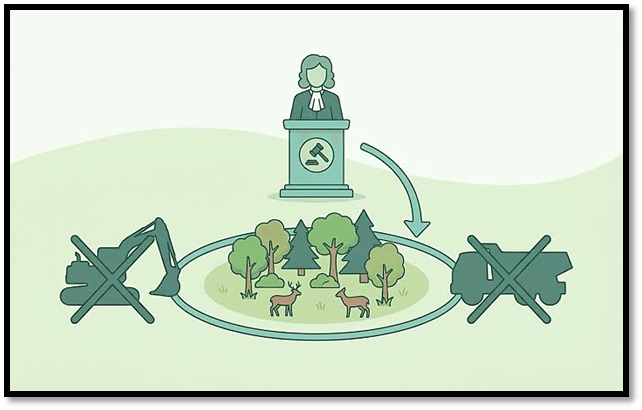
- The Supreme Court of India has clarified that its earlier direction prohibiting mining activities within a 10-km radius of the Asan Conservation Reserve (Uttarakhand) will apply uniformly to all notified wetland conservation reserves across India, ensuring parity in wetland protection.
Supreme Court Ruling: Key Highlights
- The 10-km mining restriction around the Asan Conservation Reserve (Ramsar Site) will now apply to all wetland conservation reserves in India.
- The Court held that all wetland conservation reserves belong to the same legal category, and therefore should receive equal environmental protection.
- The restriction is aimed at preventing ecological degradation caused by mining near ecologically sensitive wetlands.
- The Court observed that the distinction applicable to National Parks and Wildlife Sanctuaries does not apply to Conservation Reserves under this order.
- The clarification came while hearing a petition regarding proposed mining activities near the Asan Wetland.
Background of the Case
- In February 2024, the Supreme Court issued an interim order prohibiting mining within a 10-km radius of the Asan Wetland Conservation Reserve until prior approval from the Standing Committee of the National Board for Wildlife (NBWL) and the Ministry of Environment, Forest and Climate Change (MoEFCC).
- The Himachal Pradesh Government later argued that the Asan Wetland lies outside its territory and sought exemption.
- The Supreme Court clarified that the principle applies nationwide to all notified wetland conservation reserves.
What is a Conservation Reserve?
- A Conservation Reserve is a protected area declared under the Wildlife (Protection) Act, 1972.
- It is generally notified on government-owned land adjoining National Parks or Wildlife Sanctuaries, or in ecologically important landscapes.
- Its objective is to protect habitats, wildlife corridors and biodiversity through community participation.
- Managed with the help of a Conservation Reserve Management Committee.
About Asan Conservation Reserve
- Location: Dehradun district, Uttarakhand.
- Situated at the confluence of the Asan River and Yamuna River.
- Declared Uttarakhand’s first Conservation Reserve in 2005.
- Recognised as a Ramsar Site in 2020.
- A major habitat for resident and migratory waterbirds, especially during winter.
What is a Ramsar Site?
- A Wetland of International Importance designated under the Ramsar Convention (1971).
- Objective: Conservation and wise use of wetlands through national and international cooperation.
- India is a Contracting Party to the Convention since 1982.
- India has one of the largest networks of Ramsar Sites globally.
National Board for Wildlife (NBWL)
- Statutory body constituted under the Wildlife (Protection) Act, 1972.
- Chairperson: Prime Minister of India.
- Advises the government on wildlife conservation policies.
- Its Standing Committee considers proposals involving diversion of land or activities in and around protected areas.
| Important CTC from this article for UPSC: National Board of Wildlife Ramsar site |
Q. With reference to Conservation Reserves in India, consider the following statements:
1. They are declared under the Wildlife (Protection) Act, 1972.
2. They can be notified to protect ecologically important areas and wildlife corridors.
3. The Supreme Court has clarified that a 10-km mining buffer around wetland conservation reserves should apply uniformly across the country.
Which of the statements given above is/are correct?
A. 1 and 2 only
B. 2 and 3 only
C. 1 and 3 only
D. 1, 2 and 3
Answer: D
Statement 1: Correct. Conservation Reserves are notified under the Wildlife (Protection) Act, 1972.
Statement 2: Correct. They protect ecologically important habitats and wildlife corridors, often adjoining Protected Areas.
Statement 3: Correct. The Supreme Court clarified that the 10-km mining buffer applies to all wetland conservation reserves across India.