
About the IUCN Red List
- The IUCN Red List of Threatened Species was established in 1964 by the International Union for Conservation of Nature (IUCN), headquartered in Gland, Switzerland.
- It serves as the world’s most authoritative inventory for assessing the global conservation status of plants, animals, and fungi.
- More than 160,000 species have been evaluated globally, making it a critical indicator of global biodiversity health.
Key Assessment Criteria
- Population Reduction: Evaluates decline rates, such as over 90% reduction within ten years for Critically Endangered status.
- Geographic Range: Assesses small or shrinking distribution areas combined with habitat fragmentation or decline.
- Population Size: Thresholds based on mature individuals (e.g., fewer than 50 mature individuals indicate extreme extinction risk; fewer than 2,500 indicate Endangered status).
- Population Trend Analysis: Tracks ongoing declines in mature individuals that signal long-term instability.
- Quantitative Extinction Modelling: Uses statistical models to estimate extinction probability (e.g., a 50% likelihood within ten years qualifies as Critically Endangered).
- Threat Assessment: Incorporates scientifically justified anticipated threats such as climate change, invasive species, and overexploitation.
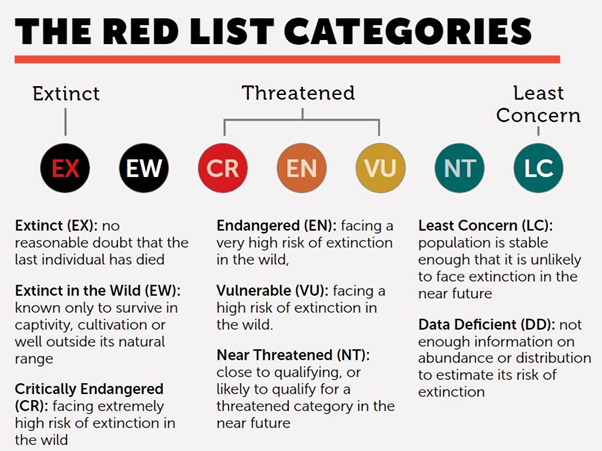
Nine IUCN Red List Categories
- Extinct (EX): No individuals remain alive after exhaustive surveys across known and expected habitats.
- Extinct in the Wild (EW): Survives only in captivity, cultivation, or outside its natural historical range.
- Critically Endangered (CR): Faces an extremely high risk of extinction in the wild.
- Endangered (EN): Faces a very high risk of extinction due to significant decline or restricted range.
- Vulnerable (VU): Faces a high risk of extinction if current threats persist.
- Near Threatened (NT): Close to qualifying for a threatened category due to emerging pressures.
- Least Concern (LC): Widespread and abundant with stable populations and low extinction risk.
- Data Deficient (DD): Insufficient data to accurately assess extinction risk.
- Not Evaluated (NE): Has not yet undergone Red List assessment.
Notable Threatened Species in India
- Critically Endangered (CR):
- Pygmy Hog: World’s smallest wild pig, restricted to Assam’s tall grasslands.
- Himalayan Brown Bear: Found in high-altitude regions of north India; threatened by habitat loss and human conflict.
- Namdapha Flying Squirrel: Endemic to Arunachal Pradesh’s Namdapha Tiger Reserve.
- Kondana Rat: Restricted to a one-square-kilometre plateau near Pune; vulnerable to tourism and grazing.
- Malabar Civet: Endemic to the Western Ghats; affected by deforestation and plantation expansion.
- Endangered (EN):
- Tiger: India hosts the largest share of the global population (which rose to 3,890 in 2015).
- Asiatic Lion: Restricted to Gir forests, Gujarat; faces disease and habitat concentration risks.
- Red Panda: Himalayan endemic threatened by habitat fragmentation and poaching.
- Hangul (Kashmir Stag): Confined to limited Himalayan habitats; impacted by grazing and degradation.
- Lion-tailed Macaque: Western Ghats endemic sensitive to habitat fragmentation.
Recent Developments
- Rising Threat Numbers: By March 2025, over 47,000 species were classified as threatened, including around 25% of assessed freshwater fish species and over 16,425 tree species.
- Ecosystem and Species Shifts: Pillar Coral moved to Critically Endangered after an over 80% decline since 1990, and over half of global bird species show declining trends; conversely, the Green Sea Turtle improved from Endangered to Least Concern due to sustained conservation.
- Green Status of Species: Introduced as a complementary framework to measure species recovery success beyond extinction risk.
Conclusion
The IUCN Red List remains the foundational global benchmark for tracking species extinction risk and guiding biodiversity conservation policy. Despite methodological challenges such as assessment lags and data gaps, its expanding coverage and complementary frameworks like the Green Status of Species are vital for informing targeted ecological protection worldwide.
| This concept has been mentioned in the following article – Indri Lemurs Use Opera-Style Vocal Techniques |