
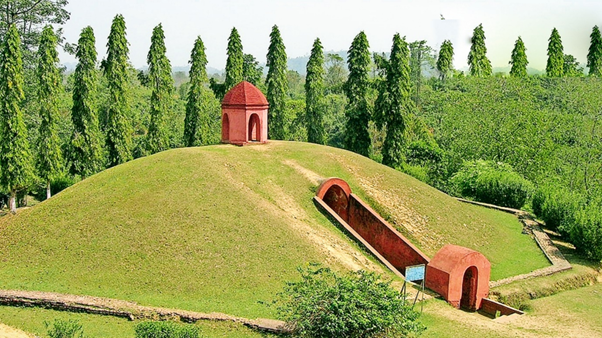
About Moidams
- Moidams represent the late medieval (13th–19th century CE) mound-burial tradition of the Tai-Ahom dynasty of Assam, serving as the resting places of Ahom royalty.
- They are located in Assam’s Charaideo district (at the foothills of the Patkai hills), where Chau-lung Siu-ka-pha, the founder of the Ahom kingdom, established his first capital (Che-rai-doi) in the 13th century.
- Often compared to the royal tombs of ancient China and the Pyramids of the Egyptian Pharaohs, Moidams enshrined the mortal remains of Ahom royals along with their personal paraphernalia.
- Following the influence of Hinduism after the 18th century, Ahom rulers adopted cremation and began entombing the cremated bones and ashes inside Moidams; however, the traditional burial system is still practised by the priestly sections of the Ahoms and the Royal bodyguards clan.
Key Architectural Features and Engineering of Moidams
- Construction Materials: Primarily constructed using earth, wood, stone, and burnt bricks, as recorded in the Changrung Phukan (a canonical text developed by the Ahoms).
- Three-Part Structure: Each Moidam comprises a vaulted chamber with a centrally raised platform for laying the body, a hemispherical earthen mound covering the chamber topped by a brick structure (Chaw-chali), and an octagonal boundary wall around the base featuring an arched gateway on the west.
- Scale and Grave Goods: The size of the hemispherical exterior varies according to the power and status of the deceased, who were buried with objects such as royal insignia, gold pendants, and items made of wood, ivory, or iron.
- Advanced Engineering and Preservation: While Moidams exist across the Brahmaputra Valley, those at Charaideo are exceptionally well preserved and showcase advanced Ahom engineering, including stable vault construction and the use of water to buffer seismic impact.
Other Prominent Burial Practices in India
| Period / Practice | Key Features |
| Harappan Civilization | Bodies were generally placed in a north-south orientation on their backs.Evidence of a coffin burial has been found at Harappa, and paired male-female skeletons buried together at Lothal. Inclusion of ornaments and objects indicates a belief in life after death. |
| Megalithic Culture | Characterized by erect stone structures over burials, tracing origins to the Neolithic–Chalcolithic period (e.g., urn burials at Inamgaon, Maharashtra).South Indian megalithic sites are broadly associated with the Iron Age and contain grave goods, pottery, and offerings. Hire Benkal (Koppal District, Karnataka) is a prominent megalithic site on the UNESCO Tentative List. |
Conclusion
The Moidams of Charaideo stand as a remarkable testament to the architectural ingenuity, seismic engineering, and funerary traditions of the Tai-Ahom dynasty. Reflecting both indigenous customs and gradual cultural synthesis with Hinduism, they form an indispensable part of India’s medieval heritage.
| This concept has been mentioned in the following article – Lachit Diwas & Legacy of Lachit Borphukan |