
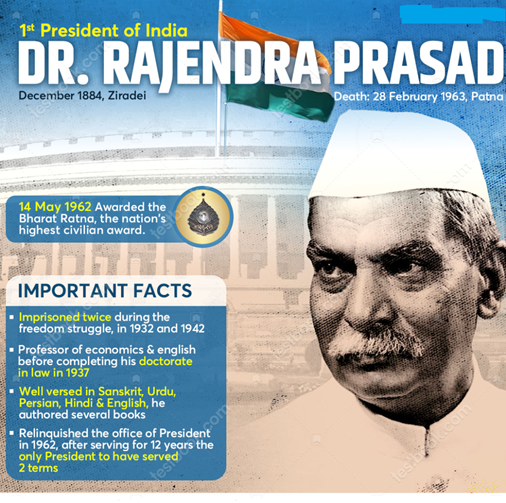
About Dr. Rajendra Prasad
- Dr. Rajendra Prasad was a prominent Indian freedom fighter, constitutionalist, and the first President of India.
- Well-versed in Persian, Hindi, and Arithmetic from an early age, he graduated from Presidency College, Calcutta as a scholarship student, completed an MA in Economics, and pursued a law degree in Kolkata in 1909.
- During his college years, he was associated with the Servants of India Society and the Dawn Society, and later served as the Principal of Langar Singh College in Bihar.
- He remains the only President of India to be re-elected twice unanimously (in 1952 and 1957), holding the office for the longest tenure of about 12 years.
- He was awarded the Bharat Ratna in 1962, the same year he retired from politics, and initiated the tradition of opening the Mughal Gardens to visitors.
Key Contributions and Literary Works
- Indian Freedom Struggle: Actively supported Mahatma Gandhi’s Champaran Satyagraha and spearheaded the Non-Cooperation Movement in Bihar. In 1921, he abandoned his law practice to establish a National College near Patna, boycotted Western educational institutions, and admitted his son to Bihar Vidyapeeth—an institution he helped establish on traditional Indian education models.
- Imprisonment for Activism: Faced multiple incarcerations, notably in 1931 for participating in the Salt Satyagraha and in 1942 for his active role in the Quit India Movement.
- Role in Congress and Constitution-Making: Elected President of the Indian National Congress at the Bombay Session (October 1934) and appointed President of the Constituent Assembly (July 1946). Under his leadership, key Constituent Assembly committees were constituted, including the Ad hoc Committee on the National Flag, Committee on the Rules of Procedure, Finance and Staff Committee, and Steering Committee.
- Literary Works: Authored several notable works documenting India’s freedom struggle, including Satyagraha at Champaran (1922), Division of India (1946), Atmakatha (1946), Mahatma Gandhi and Bihar, Some Reminiscences (1949), Bapu Ke Qadmon Men (1954), Since Independence (1960), Bharatiya Shiksha, and At the Feet of Mahatma Gandhi.
Conclusion
Dr. Rajendra Prasad’s life exemplifies intellectual rigour, Gandhian commitment, and constitutional statesmanship. From mobilizing grassroots resistance in Bihar to guiding the Constituent Assembly and setting enduring presidential precedents, his legacy remains foundational to modern Indian democracy.
| This concept has been mentioned in the following article – National Constitution Day (Samvidhan Diwas) 2026 |