
About the SAMPADA Survey
- Full Form: Survey for Assessment of Markers of Population Health, Activity, Diet and Anthropometry.
- Conducted by: Indian Council of Medical Research (ICMR), including the ICMR–National Institute of Nutrition (NIN), under the Department of Health Research, Ministry of Health and Family Welfare.
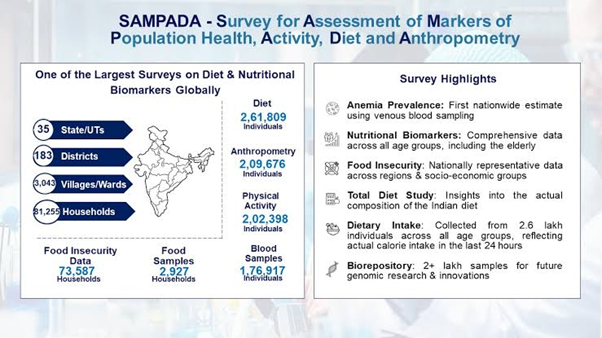
- Timeline and Scale: Conducted during 2023–2025, covering over 2 lakh individuals across 81,000 households in 183 districts spanning 35 States and Union Territories.
- Scope: Evaluates anaemia, micronutrient deficiencies, inflammation markers, diet, physical activity, and anthropometry across the entire life course.
Key Methodological Features and Findings
- Venous vs. Capillary Blood Sampling: Analysed 1.7 lakh venous blood samples to correct the overestimation of anaemia associated with capillary blood samples used in earlier surveys such as NFHS-5.
- Lower Anaemia Prevalence: Reported a lower overall anaemia prevalence compared to previous national surveys, with severe anaemia recorded in less than 2% of individuals across most age groups.
- Demographic Trends: Roughly half of anaemic women, adolescent girls, and children exhibit mild anaemia; prevalence is significantly lower among males, with three-fourths of affected males having only mild anaemia.
- Role of Micronutrients: Iron deficiency accounts for approximately half of the anaemia burden in women, adolescent girls, and children, highlighting non-nutritional drivers (infections, hemoglobinopathies, chronic inflammation). Vitamin B12 and folate deficiencies showed comparable prevalence in both anaemic and non-anaemic groups, indicating a limited contribution to anaemia in India.
- Elderly Health Data: Established India’s first nationally representative anaemia baseline for older adults.
Major Objectives and Mandates
- To generate accurate, biomarker-based national data on anaemia, micronutrient status, diet, and physical activity.
- To eliminate sampling and estimation biases in national health and nutrition surveillance.
- To inform targeted, life-course interventions and test-and-treat strategies under Anaemia Mukt Bharat 2.0.
Conclusion
The SAMPADA Survey (2023–2025) sets a new scientific benchmark for nutritional surveillance in India. By adopting venous blood biomarkers and clarifying the multi-factorial causes of anaemia, it provides a reliable evidence base to sharpen public health interventions under Anaemia Mukt Bharat 2.0.
| This concept has been mentioned in the following article : SAMPADA Survey (2023–2025) Reports Drop in Anaemia Prevalence |