
Context
- Recently, the Deputy Director of Education (DDE), Ernakulam (Kerala), has issued a strict directive ensuring that no student is denied school admission due to the lack of an Aadhaar card. This instruction emphasizes that denying enrollment violates core provisions of the Right of Children to Free and Compulsory Education (RTE) Act.
Key Highlights
- Admission vs. Benefits: While children can be enrolled in schools without an Aadhaar card, the lack of an Aadhaar card may still create hurdles in making them eligible for state-backed welfare benefits such as free uniforms, textbooks, and midday meals.
- Impact on Migrants: The directive specifically addresses the plight of migrant children, who frequently face institutional denial of education when missing standard documentation like Aadhaar.
- Administrative Oversight: Local administrative bodies, including the District Child Protection Office (DCPO) and District Collectors, are actively intervening to track and enroll students lacking documentation to guarantee compliance with constitutional mandates.
About Aadhaar: Fundamental Framework
- What it is: A 12-digit unique identity number issued to residents of India based on their biometric and demographic data.
- Statutory Body: Issued by the Unique Identification Authority of India (UIDAI), established under the Aadhaar (Targeted Delivery of Financial and Other Subsidies, Benefits and Services) Act, 2016. It functions under the Ministry of Electronics and Information Technology (MeitY).
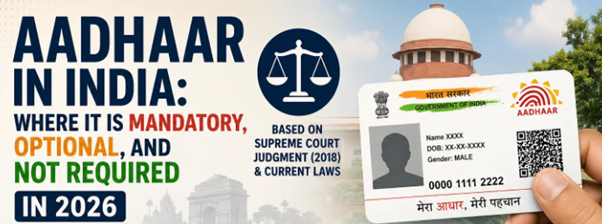
- Mandatory Provisions: The Aadhaar number is mandatory for various services and government schemes, including PAN card applications, income tax filing, and certain government subsidies.
- Commonly Used but Not Always Mandatory: Bank account KYC, Government services and welfare schemes.
- Not Mandatory in Several Cases: Birth and death registration, Many examinations and admissions.
- Legal Position on Children & Welfare (Supreme Court Judgments):
- In the landmark K.S. Puttaswamy v. Union of India (2018) case, the Supreme Court ruled that Aadhaar is not mandatory for school admissions, as education is a fundamental right.
- No child can be denied benefits from any welfare scheme (like the midday meal scheme) merely for lack of an Aadhaar number. The State must provide alternative means of identification.
About Right of Children to Free and Compulsory Education (RTE) Act, 2009
- Constitutional Backing: The RTE Act gives legal effect to Article 21A of the Indian Constitution, which makes free and compulsory education for children between the ages of 6 and 14 years a Fundamental Right.
- Key Important Provisions:
- No Denial of Admission: A child cannot be denied admission for lack of age proof, transfer certificates, or identity proof like Aadhaar.
- Prescribes minimum teacher qualifications and maintains specified pupil-teacher ratios.
- Private unaided schools must reserve 25% of entry-level seats for children from economically weaker sections (EWS) and disadvantaged groups.
- Places responsibility on the Central Government, State Governments, and local authorities for implementation and funding.
About District Child Protection Unit / Office (DCPU / DCPO)
- Statutory Origin: Set up in every district under the Juvenile Justice (Care and Protection of Children) Act, 2015 (amended in 2021).
- Nodal Scheme: It is the key implementing arm at the district level under Mission Vatsalya (formerly Child Protection Services/Integrated Child Protection Scheme) administered by the Ministry of Women and Child Development.
- Functions:
- Identifies vulnerable children (migrants, orphans, street children) and ensures their rehabilitation.
- Coordinates with Child Welfare Committees (CWCs) and Juvenile Justice Boards (JJBs).
- Ensures institutional and non-institutional care (foster care, adoption processes) is properly managed at the grassroots level.
With reference to the Right to Education (RTE) Act, 2009 and institutional mandates in India, consider the following statements:
1. Under the RTE Act, no child can be denied admission to an elementary school due to the lack of identity documentation or age proof.
2. The District Child Protection Unit (DCPU) is a statutory body established under the Protection of Children from Sexual Offences (POCSO) Act.
3. According to the Supreme Court rulings, Aadhaar cannot be made mandatory for school admissions or accessing basic fundamental rights like education.
Which of the statements given above are correct?
(a) 1 and 2 only
(b) 2 and 3 only
(c) 1 and 3 only
(d) 1, 2, and 3
Answer: C) 1 and 3 only

Explanation: Statement 1 and 3 are correct. Statement 2 is incorrect because the District Child Protection Unit (DCPU) is established under the Juvenile Justice (Care and Protection of Children) Act, not the POCSO Act.