
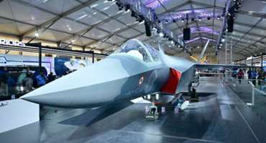
Context
- The Ministry of Defence (MoD) has officially issued a Request for Proposal (RFP) to three shortlisted domestic private bidders for the development of prototypes for India’s indigenous Advanced Medium Combat Aircraft (AMCA) programme. This marks a major paradigm shifts toward public-private partnership in advanced combat aviation under the Make in India initiative.
1. Key Highlights of the AMCA Project
- The Platform: It is India’s most ambitious indigenous aerospace programme aimed at developing a fifth-generation stealth combat aircraft.
- Core Design Elements: The multi-role aircraft will feature advanced avionics, super cruise capability (the ability to fly at supersonic speeds without using fuel-heavy afterburners), and a drastically reduced radar signature (stealth).
- Development Model (AMCA Programme Execution Model):
- Designed by the Aeronautical Development Agency (ADA), a premier body functioning under the Department of Defence R&D (DRDO).
- The execution relies heavily on a private industry partnership. The selected private player will collaborate with the ADA to manufacture five prototypes for the Indian Air Force (IAF).
- Exclusion of HAL: Interestingly, the state-run aerospace giant Hindustan Aeronautics Limited (HAL) has been kept out of this specific prototype bidding process to allow private entities to lead.
- Infrastructure Support: The foundation stone for a dedicated ₹15,803-crore AMCA infrastructure project was laid in the Sri Sathya Sai district of Andhra Pradesh to build up testing and development facilities.
2. Private Sector Participation
The RFP was issued to three distinct corporate combinations, showcasing the deep indigenisation of defense manufacturing:
- Larsen & Toubro (L&T) & Bharat Electronics Limited (BEL) combine.
- Tata Advanced Systems Limited (TASL).
- Bharat Forge & BEML Limited consortium.
3. Categorising Fighter Jet Generations
| Feature | 4th / 4.5 Generation (e.g., LCA Tejas, Rafale) | 5th Generation (e.g., AMCA, F-35, Su-57) |
| Stealth / Radar Signature | High to Moderate radar cross-section. Weapons and fuel tanks are carried externally on wing hardpoints. | Inherent low-observable stealth geometry, radar-absorbent coatings, and internal weapons bays to avoid radar detection. |
| Super cruise | Mostly absent; requires afterburners to sustain supersonic speeds, which rapidly drains fuel. | Inbuilt capability to cruise supersonically without afterburners, increasing operational range. |
| Sensor Fusion | Multiple separate displays for radar, electronic warfare, and targeting systems. | Advanced integrated networks that fuse data from AESA radars, infrared sensors, and external data links into a single, cohesive situational display. |
Consider the following statements regarding the AMCA programme:
1. The AMCA programme is being developed under the Make in India initiative.
2. Hindustan Aeronautics Limited (HAL) has been included in the prototype bidding process.
Which of the statements given above is/are correct?
(a) 1 only
(b) 2 only
(c) Both 1 and 2
(d) Neither 1 nor 2
Answer: A) 1 only
Explanation:
• Statement 1 is correct: The Advanced Medium Combat Aircraft (AMCA) programme is being developed under the Make in India initiative with a strong focus on indigenous defense manufacturing and private sector participation.
• Statement 2 is incorrect: Hindustan Aeronautics Limited has not been included in the current prototype bidding process. The Ministry of Defence shortlisted private sector combinations for prototype development.