
After Reading This Article You Can Solve This UPSC Mains Model Question:
Successful species recovery requires ecological resilience rather than mere population growth. In the context of the Asiatic lion, examine why establishing geographically separated populations is essential for long-term biodiversity conservation. 15 Marks (GS-3, Environment)
Why in News?
India has successfully increased the population of the Asiatic lion to around 891 individuals. However, conservation experts continue to stress the urgent need to establish a second geographically isolated population, as directed by the Supreme Court of India in 2013, to safeguard the species from catastrophic risks.
Introduction
While the Asiatic lion population has recovered significantly, its long-term survival remains uncertain due to its concentration in a single habitat, increasing the risk of disease, disasters, and genetic bottlenecks.
Background
While the Asiatic lion population has recovered significantly, its long-term survival remains uncertain due to its concentration in a single habitat, increasing the risk of disease, disasters, and genetic bottlenecks.
Constitutional & Legal Dimensions
- Article 48A – Directs the State to protect and improve the environment and safeguard forests and wildlife as part of its Directive Principles.
- Article 51A(g) – Imposes a Fundamental Duty on every citizen to protect and improve the natural environment and show compassion for all living creatures.
- Concurrent List – Places forests and wildlife under the shared legislative responsibility of both the Union and State Governments, promoting cooperative conservation.
- Wildlife (Protection) Act, 1972 – Provides the primary legal framework for the protection of wildlife, establishment of protected areas, and conservation of endangered species in India.
Population Recovery Data
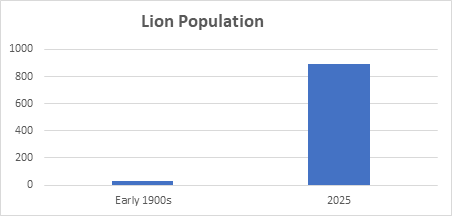
This recovery has largely resulted from
- Strong legal protection – Strict enforcement of wildlife laws and protected area management safeguarded the Asiatic lion from hunting and habitat destruction.
- Community participation – Active involvement of local communities fostered coexistence and strengthened conservation efforts.
- Habitat conservation – Protection and restoration of the Gir ecosystem ensured a secure and suitable habitat for lion populations.
- Anti-poaching efforts – Enhanced surveillance, patrolling, and law enforcement significantly reduced illegal hunting and wildlife crimes.
- Prey base improvement – Conservation of herbivore populations ensured an adequate food supply, supporting the growth and stability of the lion population.
Why is a Second Home Necessary for the Asiatic Lion?
1. Risk of Single Population Extinction
With nearly the entire global population confined to the Gir landscape, a single catastrophic event could threaten the survival of the species. Establishing a second population spreads the risk and enhances long-term conservation security.
2. Disease Outbreaks
The 2018 Canine Distemper Virus (CDV) outbreak highlighted how diseases can spread rapidly within a concentrated lion population, causing significant mortality. A geographically separated population would reduce the likelihood of a single epidemic affecting the entire species.
3. Limited Genetic Diversity
The Asiatic lion population originated from a small number of surviving individuals, resulting in low genetic diversity and increased vulnerability to diseases and inbreeding. A second population, supported by scientific translocation, can help maintain healthier genetic diversity over time.
4. Climate and Environmental Risks
Climate-induced events such as forest fires, droughts, heat waves, and habitat degradation can severely impact a single habitat. Distributing lions across multiple landscapes enhances their resilience to environmental uncertainties.
5. Scientific Recommendation: Metapopulation Approach
Conservation scientists advocate a metapopulation approach, where geographically isolated populations are managed as a single conservation unit. This reduces extinction risk, facilitates genetic exchange, and strengthens the species’ long-term ecological resilience.
Why Kuno National Park?
- Suitable habitat – Kuno provides ecological conditions similar to the Gir landscape, making it suitable for sustaining a free-ranging lion population.
- Adequate prey base – The park supports a healthy population of herbivores, ensuring sufficient food availability for lions.
- Large forest landscape – Its extensive and contiguous forest area offers ample space for territorial movement, breeding, and long-term population growth.
- Villages relocated – The relocation of villages has reduced human disturbance and created an undisturbed habitat for wildlife conservation.
- Habitat restoration completed – Scientific habitat improvement measures have enhanced the park’s ecological suitability for lion reintroduction.
- Long-term management planning – Kuno has been prepared with comprehensive conservation and monitoring plans to support the successful establishment of a second lion population.
Major Challenges in Establishing a Second Home for Asiatic Lions
1. Political Resistance and Regional Identity
Gujarat’s pride in its successful lion conservation and concerns over losing its conservation identity have led to resistance against translocating lions outside the State.
2. Centre–State Coordination and Federal Challenges
Wildlife conservation is a shared responsibility under the Concurrent List, but differences between the Union and State Governments have delayed consensus and implementation.
3. Gap Between Science, Judiciary and Policy
Despite scientific recommendations and the Supreme Court’s 2013 directive, political considerations have hindered evidence-based implementation of the translocation project.
4. Habitat Suitability and Site Selection
Concerns over the ecological suitability of alternative habitats, along with the limitation of nearby sites like Barda Wildlife Sanctuary, have complicated the selection of a truly secure second home.
5. Ecological and Operational Challenges
Translocation involves habitat management, continuous monitoring, disease surveillance, and ensuring the successful adaptation of relocated lions in a new ecosystem.
6. Human Dimensions and Conflict Management
Potential human-wildlife conflicts, interstate coordination issues, and the need for community participation and acceptance remain significant challenges to establishing a second lion population.
Supreme Court Judgment (2013): Key Observations
- Conservation should be guided by ecological science – Wildlife management decisions must be based on scientific evidence and ecological principles rather than political or regional considerations.
- Asiatic lions are National Heritage, not the property of one State – The Court held that Asiatic lions belong to the entire nation, making their conservation a collective national responsibility.
- A second free-ranging population is essential – Establishing a geographically separate lion population is necessary to reduce extinction risks and ensure the species’ long-term survival.
- Delay would increase extinction risk – Prolonged inaction in implementing translocation increases the species’ vulnerability to diseases, natural disasters, and other catastrophic events.
Way Forward
1. Implement Scientific Translocation
Implement the Supreme Court’s 2013 judgment by establishing Kuno National Park as the second free-ranging habitat and gradually develop additional suitable landscapes to strengthen species resilience.
2. Strengthen Cooperative Environmental Governance
Enhance Centre–State coordination through evidence-based policymaking, independent scientific oversight, and a time-bound mechanism for implementing conservation decisions.
3. Adopt Adaptive Scientific Management
Use modern conservation tools such as radio-collar tracking, GIS-based monitoring, and periodic genetic diversity assessments to ensure the long-term viability of lion populations.
4. Build a Robust Wildlife Health System
Establish comprehensive disease surveillance, strengthen veterinary infrastructure, and develop early warning and emergency response systems to prevent and manage wildlife epidemics.
5. Promote Community-Centred Conservation
Encourage local participation through eco-tourism, benefit-sharing, fair compensation for wildlife-related losses, and active involvement of communities in conservation programmes.
6. Develop a National Metapopulation Strategy
Create multiple geographically isolated yet scientifically managed lion populations across suitable habitats to reduce extinction risks and ensure long-term ecological resilience.
Conclusion
The success of Asiatic lion conservation must now evolve into long-term ecological resilience. Establishing a geographically separate second population is essential to reduce extinction risks and secure the future of this national heritage through science-based conservation and cooperative federalism.