
After Reading This Article You Can Solve This UPSC Mains Model Question:
Evaluate the prospects of voluntary veto restraint during humanitarian crises and discuss the structural challenges hindering comprehensive Security Council reform. 15 Marks (GS 2 International Relations)
Context
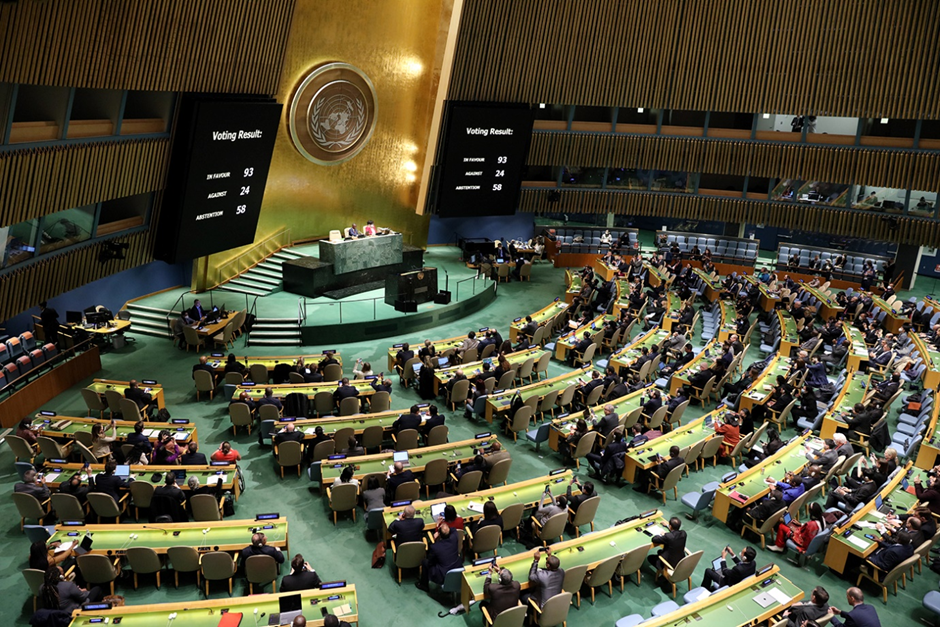
At the UN General Assembly, France and Mexico renewed their initiative to regulate the UN Security Council (UNSC) veto during mass atrocities, framing its use as an institutional “responsibility” rather than an absolute “privilege.”
Introduction
Geopolitical rivalries among permanent members frequently paralyze the UN Security Council during severe humanitarian emergencies. The renewed push for voluntary veto restraint offers a pragmatic mechanism for institutional discipline, bypassing the near-impossible legal task of formally amending the UN Charter.
The French-Mexican Initiative on Veto Restraint
- Core Commitment: Launched in 2015, it urges the P5 to voluntarily abstain from vetoing resolutions addressing genocide, crimes against humanity, and war crimes.
- Charter-Bypassing: Operates as an exercise in political self-restraint rather than a formal UN Charter amendment.
- Growing Support: Endorsed by 128 member states, including the UK, meaning two permanent members now formally support the principle.
Core Dimensions of the Veto Debate
- Usage: The foundational decision of whether to exercise the negative vote.
- Accountability: Requiring a state to publicly justify its veto before the international community.
- Structural Reform: Expanding membership categories and altering overall decision-making rules.
The Syrian Deadlock as a Reform Catalyst
- Institutional Paralysis: Persistent Russian and Chinese vetoes during the Syrian civil war paralyzed collective humanitarian intervention.
- The Ghouta Trigger: Following the 2013 Ghouta chemical attack, France proposed a code of conduct for P5 voluntary restraint during mass atrocities.
Alternative Accountability Mechanisms
- Liechtenstein Initiative (2022): Mandates a UNGA debate within 10 days of a veto, forcing the casting state to publicly defend its decision on the Assembly floor.
- ACT Code of Conduct: Urges all Security Council members (permanent and elected) to pledge against blocking credible humanitarian interventions.
Realpolitik and the Amendment Barrier
- Textual Origin: The word “veto” is absent from the Charter; it stems from Article 27(3) requiring the concurring votes of permanent members.
- Amendment Hurdle: Formal abolition under Article 108 requires a two-thirds UNGA majority and ratification by all P5 members.
- Survival Constraint: International organizations historically struggle to survive if they enforce decisions contradicting the core strategic interests of major global powers.
India’s Stance on UNSC Reform
- Group of Four (G4): Coordinates with Brazil, Germany, and Japan to advance joint bids for permanent seats.
- L.69 Coalition: Aligns with developing nations from the Global South to demand comprehensive expansion across both categories.
- Text-Based Negotiations: Advocates shifting UN talks to a single consolidated text to achieve tangible outcomes.
Significance of Regulating the Veto
- Alleviating Paralysis: Enables urgent interventions and aid delivery in crisis zones like Sudan, Lebanon, and Gaza.
- Normative Shift: Redefines the veto from an unconditional sovereign entitlement into an accountable governance duty.
- Feasible Alternative: Achieves functional reform without triggering rigid Charter amendment barriers.
- Global South Empowerment: Mobilizes broad multilateral coalitions to exert moral and political pressure on major powers.
Challenges in Disciplining the Veto
- No Legal Enforcement: Voluntary declarations cannot legally bind states acting on overriding national interests.
- Subjective Classification: The Security Council lacks an objective mechanism to universally designate “mass atrocities.”
- Unenforceable Debates: UNGA post-veto resolutions carry moral weight but lack enforcement teeth under Chapter VII.
- Hegemonic Resistance: Major powers consistently refuse to dilute an instrument central to their strategic defense.
Strategic Way Forward
- Mandate Written Justifications: Require formal written rationales in official UNSC records for any veto cast during a humanitarian crisis.
- Independent Determinations: Route atrocity classifications to independent bodies like the UN High Commissioner for Human Rights or the ICJ.
- Actionable UNGA Follow-ups: Pair mandatory post-veto debates with investigative instruments like fact-finding missions.
- Universalize the ACT Code: Encourage incoming non-permanent members to formally pledge against blocking humanitarian action.
- Accelerate Text-Based Drafting: Transition the Intergovernmental Negotiations (IGN) to formal drafting to integrate restraint protocols into broader reform packages.
Conclusion
Regulating the veto shifts UNSC reform from unattainable immediate abolition to pragmatic behavioral discipline. Ultimately, the true credibility of voluntary restraint will depend entirely on permanent members prioritizing global humanitarian protection over narrow national strategic interests.
| Important Current to Concept (CTC) from this Article for UPSC: UNSC |