
Context
The India Meteorological Department (IMD) has forecasted an increased number of heatwave days across most parts of East, Central, and Northwest India from April to June 2026. This occurs alongside concerns regarding the emergence of a “super” El Niño, which could potentially diminish monsoon rainfall and disrupt agricultural output.
1. IMD Heatwave Forecast (April–June 2026)
- Affected Regions: Above-normal maximum temperatures are expected in East, Northeast, Central India, and the adjoining peninsular regions.
- Specific States: Coastal Odisha, West Bengal, Tamil Nadu, Puducherry, Andhra Pradesh, Gujarat, Maharashtra, and Karnataka are likely to see more heatwave days in April.
- Anomalies: North India is predicted to experience a cooler-than-normal summer, with the country overall expected to receive 12% more rainfall in April due to increased western disturbances.
2. The El Niño Factor and Monsoon Performance
- Super El Niño Concerns: Forecasts suggest a potential 1+ degree Celsius warming in the Central Pacific Ocean, a pattern frequently linked to reduced rainfall in India.
- Impact on Monsoon: While cooler summers in the north typically lead to less heating of the landmass—reducing the natural “pull” for moisture—experts suggest it is still early to definitively link these to a diminished monsoon.
- Drought Management: Climatologists emphasize that if El Niño signals persist through May, the government must prioritize drought management.
3. Mechanism of Heatwaves and strategic linkages
A. Geography:
- Definition: A heatwave is a period of abnormally high temperatures, more than the normal maximum temperature.
- IMD Criteria:
- Plains: Maximum temperature reaches at least 40°C.
- Coast- The maximum temperature recorded at a station is 37 degrees Celsius or more.
- Hilly Regions: Maximum temperature reaches at least 30°C.
- Departure from Normal: Heatwave is declared if the departure from normal is 4.5°C to 6.4°C.
B. Climatology:
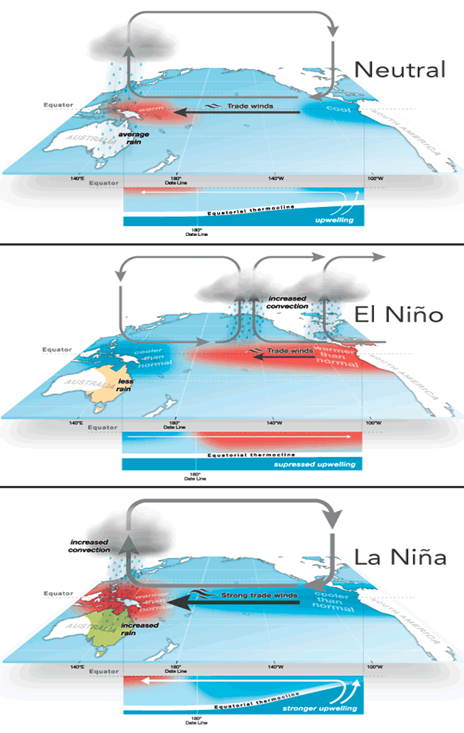
El Niño: The warming of sea surface temperatures in the Central and Eastern Pacific. It usually weakens the trade winds and results in deficient monsoon rainfall in India.
La Niña: The cooling phase, often leading to better-than-normal monsoons in India.
C. Impact on Agriculture
- Kharif Sowing: Weak rainfall and heatwaves could severely impact the sowing of Kharif crops.
- Impact on Water Resources: Heatwaves exacerbate water scarcity issues in India due to drying up of water bodies and decrease in the groundwater table.
4. Causes of Heatwaves
- Hot & Dry Air Masses: Large reservoirs of hot air spread via winds, raising temperatures.
- Low Moisture Levels: Dry air allows more solar heating and faster daytime temperature rise.
- Clear Skies: Absence of clouds permits maximum solar radiation reaching the surface.
- Anticyclonic Conditions: Anticyclones are high-pressure systems characterized by sinking air, creating stable, dry, and sunny conditions, which often cause severe heatwaves by trapping heat near the surface.
- Geographical Factors: Arid/semi-arid regions (e.g., Northwest India) are more heatwave-prone.
- Climate Change: Rising global temperatures intensify and increase frequency of heatwaves.
With reference to Heatwaves in India, consider the following statements:

1. The threshold of maximum temperature for the declaration of a heatwave is lower for plains than hilly regions.

2.  A heatwave occurs due to the movement of high atmospheric pressure into an area.

Which of the statements given above is/are correct?
(a) 1 only
(b) 2 only
(c) Both 1 and 2
(d) Neither 1 nor 2

Answer: B

Explanation:
•  Statement 1 is incorrect: According to the criteria set by the India Meteorological Department (IMD), a heatwave is declared when the maximum temperature of a station reaches at least 40°C or more for Plains and at least 30°C or more for Hilly regions. Therefore, the threshold for declaring a heatwave is actually higher for plains (40°C) than for hilly regions (30°C).
•  Statement 2 is correct: A heatwave typically occurs when high atmospheric pressure moves into an area and settles. This high-pressure system acts like a "lid," trapping heat near the ground and preventing cooler air or clouds from entering the region, which leads to a rapid increase in surface temperatures.