
Context
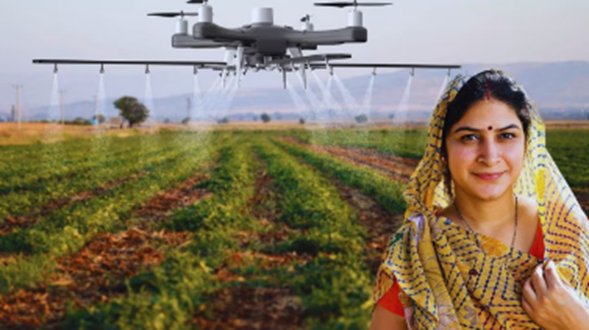
The Union Minister of State for Civil Aviation recently informed the Lok Sabha that Karnataka leads the country in training women from Self-Help Groups (SHGs) as drone pilots under the Central government’s Namo Drone Didi Yojana. The initiative aims to modernize agricultural practices while empowering rural women through advanced technical skills.
1. Key Statistics and Performance
- National Training Totals: A total of 1,094 SHG members have been trained as drone pilots across India.
- State-wise Ranking:
- Karnataka: Ranked 1st in the country with 145 members trained.
- Uttar Pradesh: Ranked 2nd with 128 members.
- Andhra Pradesh: Ranked 3rd with 108 members.
2. Features of Namo Drone Didi Yojana (NDDY)
- Objective: Central Sector Scheme to provide drones to women SHGs to improve efficiency in agricultural practices, enhance crop yield, and break traditional stereotypes of SHG activities (moving beyond home-based products like pickles/papads).
- Financial Outlay: The scheme has an allocation of ₹1,261 crore.
- Financial assistance: 80% of the total cost of the drone and accessories (up to a maximum of Rs 8 lakh) is provided by the government.
- Implementation Period: Planned for the period from 2023-24 to 2025-26.
- Target: The Central government aims to provide 15,000 drones to women SHGs under this scheme.
- Economic Impact: Trained pilots can earn significant seasonal income (up to ₹1 lakh a month) by spraying medicines/pesticides in maize and paddy farms.
- Eligibility: SHG registered under DAY-NRLM (Deendayal Antyodaya Yojana – National Rural Livelihoods Mission).
- Implementation: implemented by the Department of Agriculture & Farmers’ Welfare (DA&FW), under the Ministry of Agriculture & Farmers Welfare.
- The Lead Fertilizer Companies (LFCs) responsible for the States will be the implementing agencies of the scheme at the State level and they will establish necessary coordination with the State Departments, Drone manufacturers, Cluster Level Federations of SHGs/SHGs and the farmers/beneficiaries etc.
3. Benefits of the Namo Drone Didi Scheme
- Empowerment of Women: The scheme trains women in drone technology, enabling efficient crop monitoring, soil analysis, and precision farming.
- Enhancement of Agricultural Efficiency: Drone technology enables precise, GPS-guided application of pesticides and fertilizers, reducing chemical overuse, environmental impact, and costs for farmers.
- Skill Development and Knowledge Expansion: The scheme provides specialized training in drone technology, enabling women to acquire advanced skills in modern agricultural practices such as applying fertilizers, pesticides, and herbicides accurately, ensuring even distribution and optimal usage.
- Community and Networking Opportunities: The scheme fosters networking and collaboration among women through forums and workshops, while providing access to experts and mentors for knowledge sharing and professional growth.
Q. Consider the following statements regarding the Namo Drone Didi Yojana (NDDY):

1. It aims to provide drones to women Self-Help Groups (SHGs) to enhance agricultural efficiency.
2. The scheme is implemented as a Centrally Sponsored Scheme.

Which of the statements given above is/are correct?
(a) 1 only
(b) 2 only
(c) Both 1 and 2
(d) Neither 1 nor 2

Answer: A

•  Statement 1 is Correct: The primary objective of the Namo Drone Didi Yojana (NDDY) is to empower women Self-Help Groups (SHGs) by providing them with drones. This initiative is designed to modernize and improve the efficiency of agricultural practices, such as the precision spraying of pesticides and fertilizers.

•  Statement 2 is Incorrect: The Namo Drone Didi Yojana is a Central Sector Scheme, not a Centrally Sponsored Scheme. In a Central Sector Scheme, 100% of the funding is provided by the Union Government, whereas Centrally Sponsored Schemes involve cost-sharing between the Centre and the States. The NDDY has a total financial outlay of ₹1,261 crore for the period from 2023-24 to 2025-26