
Context
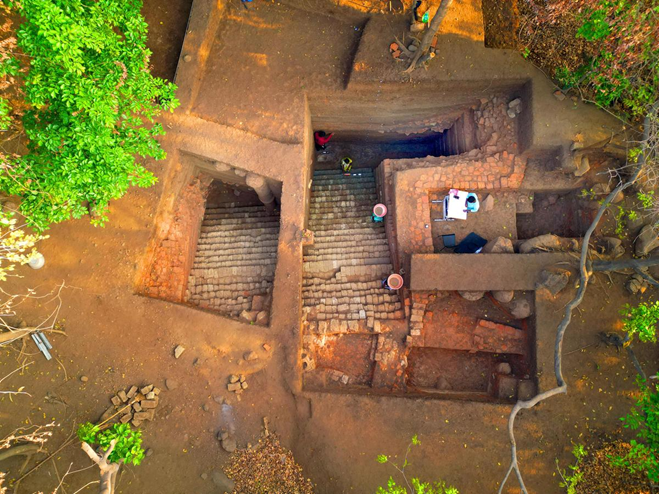
- Recently, the Archaeological Survey of India (ASI) unearthed a significant 1,500-year-old stepped reservoir at Morabandar on Elephanta Island (also known as Gharapuri) near Mumbai.
- This discovery is monumental because it reveals a sophisticated, engineered water management system distinct from the island’s famous rock-cut caves.
- The excavation also yielded silver and copper coins of the Kalachuri ruler Krishnaraja and imported pottery, providing vital links to ancient global trade networks.
1. Archaeological Highlights of the Discovery
- Structure: It is a massive T-shaped stepped reservoir approximately 14.7 meters long, built with perfectly aligned stone blocks ferried from the mainland.
- Engineering: Unlike the existing rock-cut cisterns on the island, this is a built structure, signifying a mature phase of ancient civil engineering designed to tackle the island’s rocky terrain and freshwater scarcity.
- Location: The site is located at Morabandar, one of the three ancient port localities on the island (the others being Rajbandar and Shethbandar).
- Associated Artifacts: Excavations revealed a dyeing vat for textiles, terracotta figurines, stone anchors, and over 3,000 potsherds.
2. The Kalachuri Dynasty of Mahishmati
- Timeline: Ruled during the 6th and 7th centuries CE over parts of present-day Maharashtra, Gujarat, and Malwa.
- Key Ruler (Krishnaraja): The earliest known powerful king of this dynasty (c. 550–575 CE). He was a Parama-Maheshvara (devotee of Shiva).
- Numismatic Evidence: Coins found at the site feature a seated bull (Nandi) on the obverse and a temple symbol with the legend “Siri Krishnaraja” on the reverse. These coins were widely circulated and served as a standard currency in the Western Deccan for decades.
- Cultural Legacy: Scholars believe the main Shiva complex (Cave 1) at Elephanta was likely patronized during the Kalachuri reign.
3. Ancient Maritime Trade Networks
- Amphorae Sherds: Discovery of Mediterranean amphorae (used for wine and oil) indicates strong trade links with the Roman Empire.
- Torpedo Jars: These vessels originate from Mesopotamia (West Asia) and were used to transport fish sauce and oils.
- Strategic Port: The findings confirm Elephanta Island as a critical maritime hub connecting the Indian mainland with the Persian Gulf and the Mediterranean during the Early Historic period.
4. Elephanta Caves
- UNESCO Status: Designated as a World Heritage Site in 1987.
- Architecture: Famous for rock-cut basalt sculptures, primarily dedicated to Lord Shiva.
- Iconography: Notable for the Trimurti Sadashiva (three-faced Shiva representing Creator, Preserver, and Destroyer), Nataraja, and Ardhanarishvara.
- Historical Layers: While predominantly Shaivite (5 Hindu caves), the island also contains two Buddhist caves.
- Gujarat Sultanate surrendered Elephanta to the Portuguese in 1534 who named the island “Elephanta Island” in honour of a huge rock-cut black stone statue of an elephant that was then installed on a mound.
Q. With reference to the recently discovered 1,500-year-old reservoir on Elephanta Island, consider the following statements:

1. The reservoir is a rock-cut cistern excavated directly into the basalt hills of Gharapuri.

2. Artifacts found at the site include amphorae of Mediterranean origin, suggesting ancient maritime trade.

3. Numismatic evidence from the site confirms the presence of the Kalachuri dynasty in the 6th century CE.

How many of the statements given above are correct?
(a) Only one
(b) Only two
(c) All three
(d) None

Solution: (b) Only two

• STATEMENT 1 IS INCORRECT: According to the Archaeological Survey of India, this specific reservoir is a built structure using stone blocks ferried from the mainland, not a rock-cut cistern.

• STATEMENT 2 IS CORRECT: Archaeologists recovered over 3,000 sherds of Mediterranean amphorae and West Asian torpedo jars, proving the island's role in long-distance trade.

• STATEMENT 3 IS CORRECT: Several copper and silver coins belonging to the Kalachuri ruler Krishnaraja (6th century CE) were identified based on the seated bull motif and the king's legend.