
Context
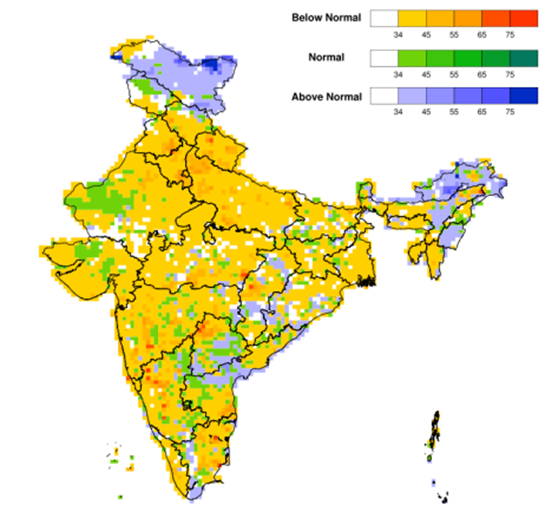
The India Meteorological Department (IMD) has projected a “below-normal” southwest monsoon for 2026, the first such forecast in 11 years. India is expected to receive only 92% of the Long Period Average (LPA) of 87 cm rainfall this year.
1. Key Climatic Drivers and Their Impact
The monsoon performance in India is heavily influenced by global atmospheric and oceanic phenomena:
- El Niño: Identified as the primary reason for the “below-normal” projection. It involves the periodic warming of the Central Equatorial Pacific. Since 1960, El Niño has emerged in 16 years and depressed Indian monsoon rainfall nine times.
- Indian Ocean Dipole (IOD): A “positive” IOD is likely to develop toward the end of the 2026 monsoon season. This condition refers to oscillations of sea-surface temperatures between the western (near Africa) and eastern (near Indonesia) tropical Indian Ocean. A positive dipole generally tends to bring more rain to India and can offset the negative impact of El Niño.
- Northern Hemisphere Snow Cover: The snow cover from January to March 2026 has been slightly below normal. Reduced snow cover is generally associated with better rainfall in India.
- Transition from La Niña: At present, the region is transitioning from “weak” La Niña-like conditions (the cooler converse of El Niño) to neutral conditions.
2. Technical Definitions and Standards
- Long Period Average (LPA): The Long Period Average (LPA) of rainfall is the average rainfall recorded over a particular region for a specific interval (e.g., month or season) calculated over a long period, typically 50 years.
- The benchmark for monsoon rainfall in India, currently set at 87 cm.
- “Below-Normal” Rainfall: Officially defined as rainfall at 90% to 95% of the LPA.
- “Deficient” Rainfall: The IMD refers to rainfall less than 90% of the LPA as “deficient” rather than using the term “drought”.
- Normal: Rainfall is considered ‘normal’ if it lies between 96% and 104% of the Long Period Average.
4. Socio-Economic Implications
- Agriculture: Insufficient rain significantly impacts farming, as Indian agriculture remains largely rainfed.
- Input Supply: Disruptions in fertilizer supply ahead of the Kharif season (anticipated due to regional wars) combined with insufficient rain could further impact productivity.
5. Role of Jet Streams
| Jet Stream | Season | Effect |
| Subtropical Westerly Jet | Winter | Brings western disturbances to North India |
| Tropical Easterly Jet | Summer | Drives and sustains Southwest Monsoon |
| Somali Jet | Summer | Low-level jet that transports moisture from Arabian Sea to India |
With reference to monsoon classifications used by the India Meteorological Department, consider the following:
1.	Below-normal rainfall is defined as 90%–96% of LPA.
2.	Deficient rainfall is less than 90% of LPA.
3.	Deficient rainfall is officially termed as drought by IMD.

Which of the statements given above is/are correct?
(a) 1 and 2 only
(b) 2 and 3 only
(c) 1 and 3 only
(d) 1, 2 and 3

Answer: A
Explanation:
Statement 1 is Correct: The India Meteorological Department (IMD) defines "below-normal" rainfall as being between 90% and 96% of the Long Period Average (LPA).
Statement 2 is Correct: Rainfall is classified as "deficient" when the actual precipitation is less than 90% of the LPA.
Statement 3 is Incorrect: The IMD’s official parlance does not use the term "drought" to describe rainfall levels. Instead, it refers to rainfall less than 90% of the LPA simply as "deficient". The term "drought" is generally avoided in their official meteorological forecasts.