
Context
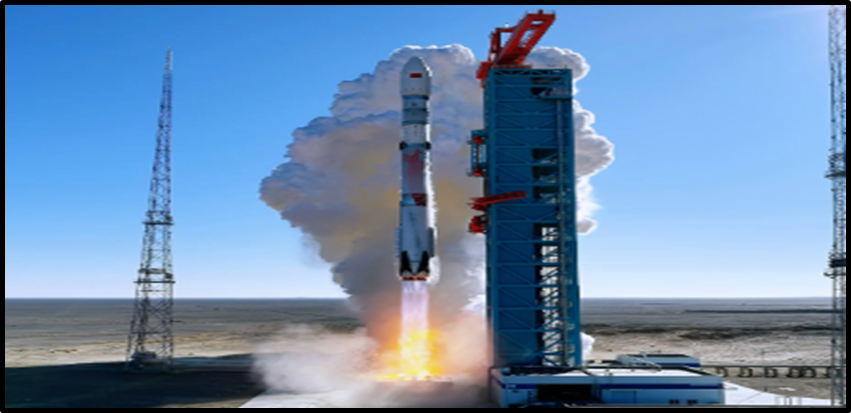
Recently, China successfully recovered the first stage of its reusable Zhuque-3 rocket on land for the first time, using deployable landing legs. Developed by private firm LandSpace, this was China’s second rocket-stage recovery after the Long March-10B was recovered at sea on July 10.
Globally, LandSpace became the third entity after SpaceX and Blue Origin to land an orbital-class rocket booster on legs.
About Zhuque-3
- Developer: Built by LandSpace, a Beijing-based private commercial aerospace company; approved by the China National Space Administration (CNSA) as a new-generation reusable launch vehicle.
- Propulsion: Powered by liquid oxygen-methane engines (Tianque-series); the first stage uses nine such engines.
- Configuration: Single-core, two-stage, stainless-steel launch vehicle with an overall length of 66.1 metres and a body diameter of 4.5 metres.
- Purpose: Designed for low-cost, high-capacity, high-frequency satellite launches.
Recovery Details of First stage of Zhuque-3
- Landing Method: First Chinese use of deployable landing legs for a land-based controlled recovery of a rocket’s first stage.
- Landing Site: Recovery completed at a designated site in Minqin County, Gansu Province.
- Payload: The second stage placed the Honghu-03 satellite into its preset orbit.
- Xinhua’s Assessment: Described as a major breakthrough in China’s reusable rocket technology.
Significance
- Major technological achievement: China has successfully recovered a rocket’s first stage on land for the first time.
- Reusable rockets: Recovering and reusing rocket stages can reduce the cost of space launches.
- Boost to China’s space programme: It strengthens China’s ability to develop reusable launch vehicles and compete in the global space sector.
- Faster space missions: Reusable rockets can potentially allow more frequent launches because the recovered hardware can be used again.
- Strategic importance: It improves China’s independent space-launch capability and supports its long-term ambitions in space.
- Global competition: The achievement shows China is advancing in an area where companies such as SpaceX and Blue Origin have already demonstrated rocket recovery and reuse.
- China had previously recovered a rocket stage at sea in July; this is its first successful recovery on land.
| Important CTC from this article ZHUQUE-3 Reusable Rocket Technology |
Q. With reference to the recent Zhuque-3 rocket recovery, consider the following statements:
I. Zhuque-3 is a rocket developed by the China National Space Administration (CNSA).
II. Zhuque-3’s first stage was recovered on land using deployable landing legs.
III. The first stage of the Long March-10B rocket was recovered on a platform at sea in July.
Which of the statements given above is/are correct?
a. I and II only
b. I and III only
c. II and III only
d. I, II and III
Answer: c. II and III only
Explanation
Statement I is Incorrect: Zhuque-3 is developed by LandSpace, a private Chinese commercial aerospace company; it is approved for launch by the China National Space Administration (CNSA), but not developed by it.
Statement II is Correct: The Zhuque-3 first stage was recovered on land using deployable landing legs, the first such recovery for China.
Statement III is Correct: The Long March-10B’s first stage was recovered via a net-capture system on a platform at sea on July 10.