
After Reading This Article You Can Solve This UPSC Mains Model Question:
Analyse the significance of the Ice Cube Neutrino Observatory in advancing multi-messenger astronomy. Examine the persistent challenges and future prospects of the India-based Neutrino Observatory (INO) in this context. 15 Marks, (GS 3, Science & Technology)
Context
The 2026 Nobel Prize in Physics was awarded to Francis Halzen for developing the IceCube Neutrino Observatory, successfully detecting high-energy cosmic neutrinos and opening a new frontier in astrophysics.
Introduction
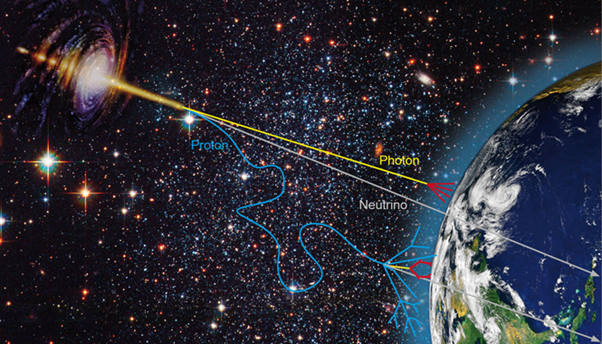
For centuries, humanity observed the cosmos using the electromagnetic spectrum. Neutrino astronomy shifts this paradigm by using elusive subatomic particles to trace the universe’s most violent and obscured cosmic events, unhindered by interstellar dust or magnetic fields.
What Are Neutrinos?
- Neutrinos are fundamental, electrically neutral subatomic particles belonging to the lepton family.They interact incredibly weakly with matter, allowing billions of them to pass through planets and human bodies unhindered every second.
Three Types (Flavors) of Neutrinos
- Electron Neutrino: Primarily produced during massive nuclear fusion reactions within stellar cores, like the Sun.
- Muon Neutrino: Created when high-energy cosmic rays collide with atomic nuclei in the Earth’s upper atmosphere.
- Tau Neutrino: The rarest flavor, associated with heavy tau leptons in extreme high-energy environments.
What is the Ice Cube Neutrino Observatory?
- Definition: A massive, gigaton-scale scientific instrument located at the Amundsen-Scott South Pole Station.
- Scale: It transforms a full cubic kilometre of deep Antarctic glacial ice into the world’s largest natural particle detector.
Why is Ice Used to Detect Neutrinos?
- Extreme Clarity: Deep Antarctic ice is exceptionally pure, bubble-free, and pitch-black.
- Stable Medium: It acts as an undisturbed natural matrix to capture faint light signals, completely shielded from surface background radiation.
How Does Ice Cube Work?
- Particle Interaction: When a high-energy neutrino rarely collides with an atomic nucleus in the ice, it generates secondary charged particles.
- Light Detection: These charged particles emit faint flashes of blue light (Cherenkov radiation), which are captured by over 5,160 embedded optical sensors to reconstruct the neutrino’s origin.
India’s Contribution to Neutrino Physics
- Historical Legacy: India pioneered atmospheric neutrino detection, recording the world’s first interaction in 1965 at the Kolar Gold Fields.
- The INO Project: The proposed India-based Neutrino Observatory (INO) in Tamil Nadu aims to use a 50,000-tonne Magnetized Iron Calorimeter (ICAL) to uniquely distinguish between neutrinos and anti-neutrinos.
Significance of the Nobel-Winning Discovery
- Multi-Messenger Astronomy: Establishes an independent method to observe cosmic bodies hidden by dense interstellar dust.
- Tracing Cosmic Accelerators: Pinpoints the elusive origin points of ultra-high-energy cosmic rays in distant galaxies.
- Probing Extreme Environments: Captures real-time dynamics inside exploding stars and black holes without signal degradation.
- Advancing Particle Physics: Provides empirical data on neutrino mass hierarchy and behaviors beyond the Standard Model.
- Innovative Infrastructure: Proves that massive natural geological features can serve as high-precision, cost-effective scientific labs.
Challenges Plaguing Mega-Science Projects
- Ecological and Wildlife Conflicts: Domestic projects like INO face severe delays due to proximity to eco-sensitive zones and tiger corridors.
- Public Misinformation: Local communities often mistakenly associate non-radioactive neutrino observatories with nuclear threats, halting progress.
- Low Interaction Rates: Neutrinos so rarely interact with matter that capturing them requires impossibly large and expensive gigaton-scale detectors.
- Hostile Operational Environments: Installing sensitive electronics deep in polar ice or excavating solid rock involves extreme engineering and logistical risks.
- Sustaining Mega-Budgets: These projects require decades of continuous funding, making them vulnerable to shifting political and fiscal priorities.
Way Forward
- Proactive Science Communication: Launch transparent, vernacular campaigns to demystify neutrino science and address public radiation fears.
- Eco-Friendly Engineering: Adopt zero-impact green tunneling and safe muck disposal to secure swift environmental clearances for INO.
- Dedicated Funding Streams: Utilize platforms like the Anusandhan National Research Foundation (ANRF) to ring-fence sustained mega-science budgets.
- Deepening Global Ties: Keep Indian physicists embedded in international projects like IceCube to retain access to cutting-edge data and global expertise.
- Indigenous Manufacturing: Leverage the Make in India initiative to locally produce high-purity sensors, photomultiplier tubes, and magnetized steel.
- Building Academic Talent: Integrate experimental particle physics into university curricula to train a new generation of scientists for future labs.
Conclusion
The 2026 Physics Nobel underscores that bold investments in fundamental physics yield transformative scientific leaps. For India, reviving the stalled India-based Neutrino Observatory is imperative not only to reclaim its historical leadership in experimental physics but also to prevent academic brain drain and secure a sovereign role in the next generation of cosmic exploration.
| Important Current to Concept (CTC) from this Article for UPSC: 1. Indian Neutrino Observatory (INO) 2. Cherenkov Radiation |