
Context
Recently, around 60,000 migrants reportedly crossed from Morocco into Ceuta, Spain’s autonomous territory in North Africa, in a single day. Spain termed the incident a violation of its territorial integrity and blamed human trafficking networks for facilitating the crossings.
About Ceuta
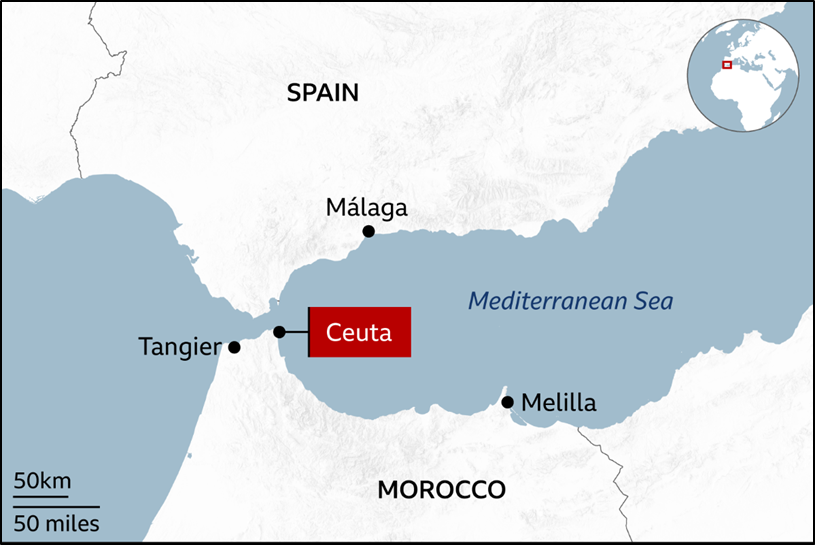
- Ceuta is a strategically important Spanish autonomous city located on the North African coast, sharing a land border with Morocco.
- Autonomous city of Spain since 1995
- Shares an approximately 8 km land border with Morocco
- One of the European Union’s external borders (Spain is an EU member)
- Along with Melilla, it is one of Spain’s two enclaves in North Africa
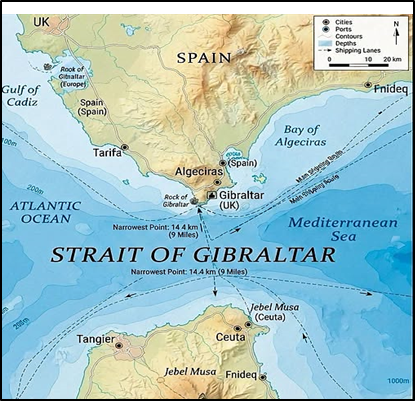
- Connected to mainland Spain by ferry across the Strait of Gibraltar
Ceuta and Melilla: Why are they Important?
- Serve as the only land borders between the European Union (EU) and Africa.
- Major entry points for irregular migration into Europe.
- Frequently witness attempts to cross through border fences or by sea.
- Have been the focus of cooperation between Spain, Morocco and the EU on border management.
Why is Ceuta Strategically Significant?
- Controls access to the Strait of Gibraltar, a vital international maritime chokepoint.
- Important for European border security and migration management.
- Holds geopolitical significance due to Spain–Morocco territorial claims.
- Plays a key role in monitoring illegal migration, trafficking and smuggling.
| Major International Frameworks on Human Trafficking UN Convention against Transnational Organized Crime (UNTOC), 2000 • Also known as the Palermo Convention. • Aims to combat transnational organised crime through international cooperation. Palermo Protocol (2000) Officially known as the Protocol to Prevent, Suppress and Punish Trafficking in Persons, Especially Women and Children. |
Difference between Refugee, Asylum Seeker and Migrant
| Refugee | Asylum Seeker | Migrant |
| Forced to flee due to persecution or conflict | Person seeking recognition as a refugee | Moves mainly for work, education or better opportunities |
| Protected under the 1951 Refugee Convention | Awaiting decision on refugee status | May migrate legally or irregularly |
| Cannot be forcibly returned (Non-refoulement) | Receives temporary protection during application | Governed mainly by domestic immigration laws |
| Important CTC from This Article for UPSC 1. Ceuta |
Q. With reference to Ceuta and human trafficking, consider the following statements:
1. Ceuta is an autonomous city of Spain located in North Africa.
2. Ceuta and Melilla together constitute the only land borders between the European Union and Africa.
3. The Palermo Protocol supplements the UN Convention against Transnational Organized Crime (UNTOC).
Which of the statements given above is/are correct?
a. 1 and 2 only
b. 2 and 3 only
c. 1, 2 and 3
d. 1 and 3 only
Answer: c. 1, 2 and 3
Explanation
• Statement 1 is Correct: Ceuta is a Spanish autonomous city situated on the North African coast.
• Statement 2 is Correct: Ceuta and Melilla are the only land borders connecting the European Union with Africa.
• Statement 3 is Correct: The Palermo Protocol is a supplementary protocol to the UN Convention against Transnational Organized Crime (UNTOC).