
Important for GS Prelims – Economy
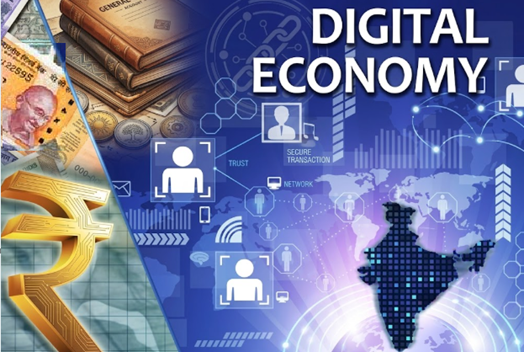
About Digital Economy
- Digital Economy refers to economic activity from digital infrastructure, platforms, and digitally-enabled sectors – measured via Gross Value Added (GVA) and Gross Domestic Product (GDP).
- Anchored on Digital Public Infrastructure (DPI), also called India Stack – a protocol-based, open-network model.
- Comprises three GVA segments: Digitally Enabling Core Industries, Digital Platforms & Intermediaries, Digitalization of Traditional Sectors.
Key Facts on India’s Digital Economy
| Particular | Details |
| Share of GDP (2024-25) | 13.42%; 2026 estimate: 12–14% |
| Productivity vs. rest of economy | ~5x more productive |
| Global digitalization rank | 3rd largest digitalised economy; 12th among Group of Twenty (G20) in individual-user digitalization |
| IndiaAI Mission budget | ₹10,371.92 crore; 34,000+ Graphics Processing Units (GPUs) |
| DPI 2.0 target | 1 million startups by 2035 (~20% annual growth) |
Sector Wise- Landscape
India is undergoing a rapid digital transformation driven by widespread industry adoption, expanding digital public infrastructure, and focused inclusivity and skilling initiatives.
- In Banking, Financial Services and Insurance (BFSI) over 95% of banking payment transactions are digital but loans/investments still largely offline.
- Retail trading is shifting to omni-channel; wholesale digitalizing slower than retail.
- In Education, Hospitality and Logistics hybrid/Artificial Intelligence (AI)-integrated models are used.
- A public Wi-Fi hotspot scheme- PM-WANI (Prime Minister’s Wi-Fi Access Network Interface) has been upgraded on May 2026 with Quick Response (QR)-based logins to standardized Service Set Identifiers (SSIDs).
- AI translation platform Bhashini can translate upto 35+ languages with the help of 1,600+ AI models. It has been integrated with Indian Railway Catering and Tourism Corporation (IRCTC) and National Payments Corporation of India (NPCI).
Policy & Regulatory Framework related to Digital Economy
- Information Technology (IT) Act, 2000 – Recognizes electronic records, digital signatures, intermediary liability.
- DPDP Act, 2023 (effective 2024) India’s first data protection law; consent-centric, defines “Data Fiduciaries,” protects children’s data..
- RBI regulatory vigilance – tightened rules on Peer-to-Peer (P2P) and digital lending apps.
- Ministry of Home Affairs (MHA)’s Indian Cyber Crime Coordination Centre and 1930 helpline combat digital payment fraud.
Related Concepts
- India’s Digital Public Infrastructure (DPI) is built on four core layers: Identity, Paperless, Cashless, and Consent, which is securely managed by the RBI-regulated Account Aggregator framework.
- The cashless ecosystem is highly adaptable thus offering UPI for instant bank-linked transfers, the RBI’s e ₹ (digital currency), and e-RUPI—a prepaid voucher system that requires no bank account.
- As NITI Aayog steers the domestic ecosystem from basic digital inclusion (DPI 1.0) toward a productivity-driven DPI 2.0 (2025–2035), this homegrown technology is rapidly expanding globally, with UPI now live across eight countries.
Conclusion
India’s digital economy, anchored on DPI/India Stack, contributes over 13% of GDP and is projected to near 20% of GVA by 2029-30. Its growth spans core industries, platforms, and emerging DPIs (ONDC, Bhashini, Agri Stack), governed by the IT Act 2000 and DPDP Act 2023.
| This CTC has been elaborately explained in India’s Data Centre Capacity to Touch 12 GW by 2030 |