
Important for GS Prelims – Economic Geography
Introduction
Coal remains India’s most abundant fossil fuel, driving ~55% of the country’s energy needs. Despite a 700% surge in commercial energy consumption over the last forty years, India’s per capita usage (~350 kgoe/year) remains significantly lower than developed nations.
Coal retains its central role due to limited domestic petroleum and natural gas reserves, ecological restrictions on hydroelectric projects, and geopolitical hurdles hindering rapid nuclear energy expansion.
Domestic Production & Distribution
- Strategic Distribution: Coal India Limited (CIL) regulates domestic supply chains through targeted Regional and Sub-Sales Offices, ensuring efficient delivery to distinct consuming sectors..
About Gondwana & Tertiary Coal
- Gondwana coal (around 250 million years old): accounts for 98% of reserves and 99% of production; found exclusively in the Peninsular plateau.
- Tertiary coal (15-60 million years old): low carbon, high moisture and sulphur; confined mainly to extra-Peninsular India (J&K, Himachal Pradesh, Assam, Arunachal Pradesh, Meghalaya, Nagaland).
- Damuda Series (Lower Gondwana) hosts the best-worked coalfields — 80% of India’s total coal production and 80 of India’s 113 coalfields.
- Gondwana basins occur along river valleys — Damodar, Mahanadi, Son, Godavari-Wardha.
- Coking coal (high carbon, low sulphur/ash; used for metallurgical coke) is distinguished from non-coking/thermal coal (high sulphur; used for power generation).
- Lignite and peat are lower-rank Tertiary coal forms; anthracite is virtually absent in Gondwana fields.
Key Facts
| First coal mine | Raniganj, West Bengal (1774) |
| Nationalisation | Coal industry nationalised in 1973-74 |
| India’s global rank | 3rd largest coal producer (after China, USA) |
| Largest coalfield | Raniganj (West Bengal) |
| Richest coal seam | Jhingurda seam, Singrauli (Madhya Pradesh) — 131 m thick |
| Top state (reserves) | Jharkhand (~26.76% of total reserves) |
| Top state (total production) | Chhattisgarh |
| Top coking-coal producer | Jharkhand (over 90% of India’s coking coal) |
| Largest lignite reserves/production | Tamil Nadu — Neyveli field, Cuddalore district (largest lignite deposit in South-East Asia) |
Regional & State-wise Distribution
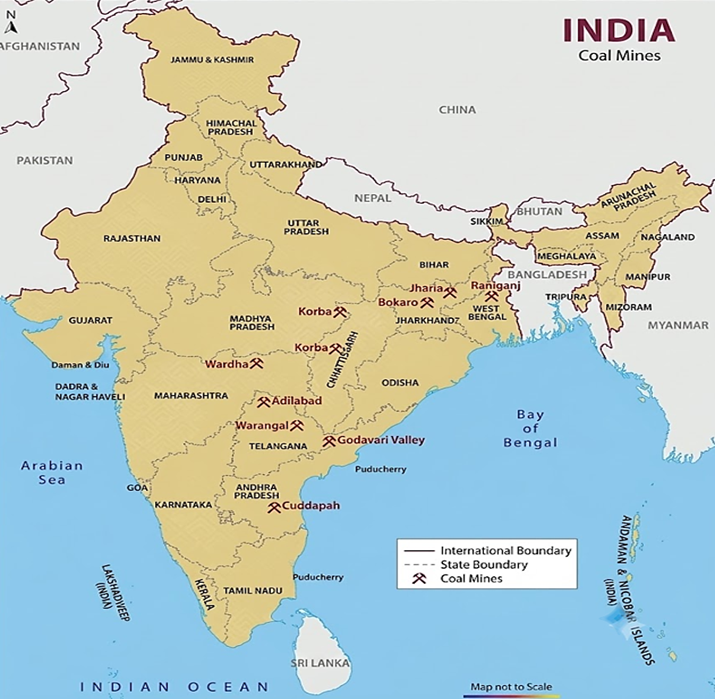
- Jharkhand: 1st in reserves (28%), 2nd in production (20%); Jharia (best coking coal), Bokaro, Giridih, Karanpura fields.
- Odisha: 2nd in reserves after Raniganj; Talcher (steam/gas coal, fertiliser plants) and Ib River fields.
- Chhattisgarh: Korba, Hasdo-Arand and Sonhat fields, mainly in Korba and Surguja districts.
- Madhya Pradesh: Singrauli (largest MP coalfield) and Pench-Kanhan-Tawa fields.
- Andhra Pradesh/Telangana: Singareni and Kothagudam collieries in the Godavari valley — southernmost coalfields, entirely non-coking.
- Tertiary belt:The Tertiary coalfields are strictly confined to the extra-Peninsular regions, specifically along the Patkai range and the Meghalaya plateau.
- Assam: Hosts the most economically significant Tertiary coalfields.
- Makum Coalfield: The largest and most productive in the region (Tinsukia district).
- Other Major Fields: Dilli-Jeypore and Koilajan.
- Meghalaya: Deposits are scattered across the Garo, Khasi, and Jaintia Hills.
- Major Fields: West Daranggiri, Cherrapunji, Mawlong-Shella, Langrin, and Balphakram-Pendenguru.
- Arunachal Pradesh:
- Major Fields: The Namchik-Namphuk coalfield (Tirap district) is the most prominent, along with Miao Bum.
- Nagaland:
- Major Fields: Borjan (often historically referred to as the Nazira coalfield), Tiru, Tuen Sang, and Jhanzi-Disai.
What are the Major Environmental and Regulatory Challenges in Coal Mining?
- Rat-Hole Mining: Because coal seams in the North-East (especially Meghalaya) are notoriously thin and erratic, traditional heavy machinery mining is unviable. This led to the dangerous practice of “rat-hole mining,” where narrow horizontal tunnels are dug into the hillsides.
- Ecological Impact: This unscientific mining leads to severe acid mine drainage, turning local rivers (like the Lukha river) blue/toxic and devastating local aquatic life.
- Regulatory Action: The National Green Tribunal (NGT) actively monitors and has heavily restricted/banned these practices due to the profound environmental degradation and fatal accidents.
Policy & Regulatory Framework
- Nodal Ministry: Ministry of Coal.
- Coal industry nationalised in 1973-74; Coal India Limited (CIL) is the apex public-sector coal producer.
- Commercial coal mining opened to the private sector (2015 onward) under reforms allowing private participation in coal production.
Current Import Policy
- Free Import Status: Under the current regulatory framework, coal is categorized under the Open General Licence (OGL). This allows consumers to freely import coal based on their commercial prudence and operational requirements.
- Coking Coal Deficit: The iron and steel sector (including SAIL) heavily imports coking coal to bridge the gap between low indigenous availability and the high-quality metallurgical requirements of steel production.
Non-Coking Coal & Coke Demand: Non-coking coal is actively imported by thermal power stations, cement factories, and sponge iron plants. Meanwhile, refined coke is primarily imported by pig-iron manufacturers utilizing mini-blast furnaces
India’s coal geography is defined by the age-based Gondwana-Tertiary divide, with Jharkhand, Odisha and Chhattisgarh dominating Gondwana reserves and production, while Tamil Nadu leads in lignite — a distribution pattern with direct bearing on coking/non-coking coal use and regional industrial location.
| This CTC has been elaborately discussed in the article Coal Exchange Rules, 2026 to Regulate Online Trading of Coal |