
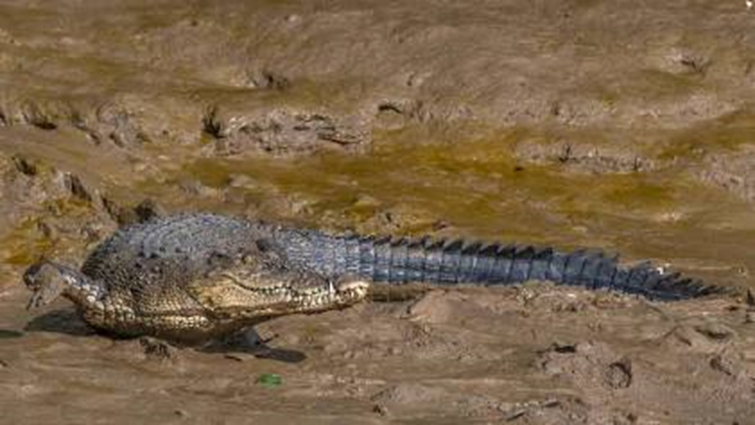
Important for GS Prelims: Environment
Biological Facts
- Size: It is the largest living reptile and crocodilian species on Earth. Males can grow up to 6 meters (20 feet) or more.
- Salinity Tolerance: Unlike other crocodilians, it is euryhaline—meaning it can tolerate a wide range of salinities. It possesses specialized salt glands behind its tongue that excrete excess salt, allowing it to live in high-salinity marine environments and travel long distances at sea.
- Ecological Role: As an apex predator, it sits at the very top of the food chain in coastal and estuarine ecosystems, regulating the populations of prey species.
Geographical Distribution & Habitats
- Global Range: Widely distributed from India’s eastern coast across Southeast Asia to northern Australia.
- Habitat Type: Primarily found in mangrove swamps, estuaries, coastal deltas, lagoons, and lower reaches of rivers.
- Core Distribution in India:
- Bhitarkanika National Park (Odisha): Home to the largest population of saltwater crocodiles in India. The park’s unique mangrove ecosystem provides an ideal breeding ground.
- The Sundarbans (West Bengal): Found in the dense network of tidal waterways and mangrove forests.
- Andaman and Nicobar Islands: Distributed across the marine creeks and coastal waters of the archipelago.
Legal and Conservation Status
| Authority / Act | Status |
| IUCN Red List | Least Concern (Globally) |
| CITES | Appendix I (In India and most range states) |
| Wildlife Protection Act (WPA), 1972 | Schedule I (Afforded the highest level of legal protection in India) |
Comparison: The Three Crocodile Species of India
| Parameter | Saltwater Crocodile | Mugger (Marsh Crocodile) | Gharial |
| Scientific Name | Crocodylus porosus | Crocodylus palustris | Gavialis gangeticus |
| Habitat | Saltwater, Estuaries, Mangroves | Freshwater lakes, rivers, marshes | Clear, fast-flowing freshwater rivers |
| IUCN Status | Least Concern | Vulnerable | Critically Endangered |
| WPA 1972 Status | Schedule I | Schedule I | Schedule I |
| Key Location | Bhitarkanika, Sundarbans, A&N | Pan-India (e.g., Chambal, Gujarat) | National Chambal Sanctuary |
Major Threats & Conservation Initiatives
- Threats: Habitat fragmentation due to aquaculture and coastal development, illegal poaching for skin/leather, and growing Human-Crocodile Conflict in densely populated areas near mangrove forests.
- Indian Crocodile Conservation Project: Launched in 1975 with the assistance of the United Nations Development Programme (UNDP) and the Food and Agriculture Organization (FAO). The project successfully used a “rear-and-release” methodology to bring back all three crocodile species from the brink of extinction in India.
| This concept has been elaborately discussed in the following article: Mangrove Restoration in Sundarbans: West Bengal’s Plan to Reclaim Encroached Forests |