
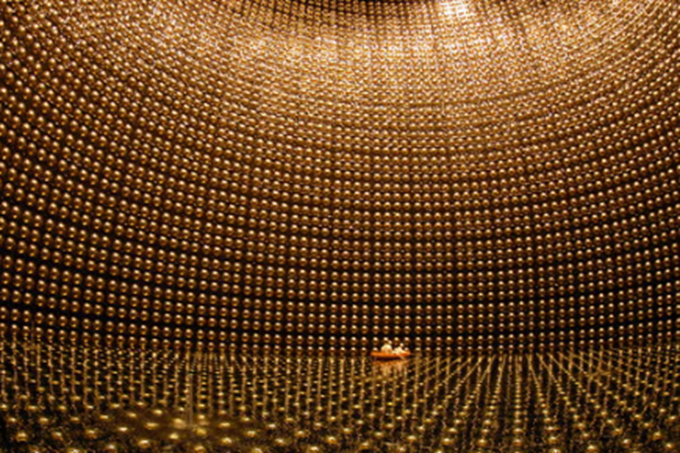
About Neutrinos
- Neutrinos are electrically neutral, extremely light subatomic particles that interact very weakly with matter.
- They are among the most abundant particles in the Universe and can travel across enormous cosmic distances.
- Because they rarely interact with matter, neutrinos can pass through stars, planets and other cosmic objects with little disturbance.
- Neutrinos are produced in several natural and astrophysical processes, including nuclear reactions in the Sun, supernovae and cosmic-ray interactions.
Key Properties of Neutrinos
- They have no electric charge.
- They have an extremely small but non-zero mass.
- They interact primarily through the weak nuclear force and gravity.
- Neutrinos exist in three known flavours:
- Electron neutrino
- Muon neutrino
- Tau neutrino
- Neutrinos can change from one flavour to another, a phenomenon known as neutrino oscillation.
What is Neutrino Oscillation?
- Neutrino oscillation refers to the phenomenon in which a neutrino changes from one flavour to another as it travels.
- It provides evidence that neutrinos have mass, contrary to the earlier assumption that they were massless.
- The discovery of neutrino oscillations was recognised with the 2015 Nobel Prize in Physics.
How are Neutrinos Detected?
- Neutrinos are extremely difficult to detect because they rarely interact with matter.
- Large detectors are therefore required to increase the probability of detecting an interaction.
- When a neutrino interacts with matter, it can produce a charged particle.
- The charged particle may generate Cherenkov radiation, a characteristic blue light that can be detected by sensitive optical sensors.
IceCube Neutrino Observatory
- IceCube is a large neutrino observatory located at the South Pole, Antarctica.
- It uses nearly 1 cubic kilometre of Antarctic ice as the detection medium.
- It contains about 5,160 optical sensors embedded in the ice.
- Its major scientific focus is the detection of high-energy astrophysical neutrinos.
- IceCube has helped scientists identify neutrinos originating from distant cosmic sources, including a blazar.
Why are Neutrinos Important?
- Neutrinos provide a new way of studying the Universe and extreme astrophysical environments.
- Unlike electromagnetic radiation, they can pass through dense cosmic matter relatively undisturbed.
- Their detection can provide information about supernovae, black holes, cosmic rays and other energetic phenomena.
- Neutrino astronomy therefore complements conventional electromagnetic astronomy.
Neutrinos in India
- India is participating in neutrino research through major scientific institutions.
- The proposed India-based Neutrino Observatory (INO) aims to study neutrino properties, particularly neutrino oscillations.
- The proposed observatory is associated with Theni district, Tamil Nadu.
Conclusion
Neutrinos are often called “ghost particles” because of their extremely weak interaction with matter. Their study has opened a new window for understanding both fundamental particle physics and the most energetic phenomena in the Universe.
| This concept has been elaborately discussed in the – Nobel Prize in Physics 2026: IceCube Neutrino Observatory |